
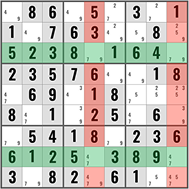
The W-Wing is an advanced Sudoku technique that uses two bivalue cells (cells with exactly two candidates) containing the same pair of digits, connected by a strong link on one of those digits. The W-Wing is one of the most frequently applied advanced techniques in Evil difficulty puzzles on SudokuPulse, averaging about 4 applications per solve.
Prerequisites
Before learning the W-Wing, you should be comfortable with:
- Candidate notation (pencil marks) — complete candidates in every cell
- Naked singles and hidden singles — foundational solving
- Naked pairs — the W-Wing extends naked pair logic
- Strong links — understanding that when a candidate appears in exactly two cells in a house, those cells form a strong link (if one is false, the other must be true)
What is a W-Wing?
A W-Wing requires three elements:
- Two bivalue cells that both contain the same pair of candidates {A, B}. These cells must NOT be in the same house (otherwise they’d be a naked pair).
- A strong link on digit A that connects a cell that sees the first bivalue cell to a cell that sees the second bivalue cell. The strong link means digit A appears in exactly two cells in some house, and those two cells each see one of the bivalue cells.
- The elimination: digit B can be removed from any cell that sees both bivalue cells.
Why It Works
Consider the two bivalue cells, each containing {A, B}:
- If the strong link resolves digit A to a cell that sees bivalue cell 1, then cell 1 can’t be A, so cell 1 = B
- If the strong link resolves digit A to a cell that sees bivalue cell 2, then cell 2 can’t be A, so cell 2 = B
- One end of the strong link must be true — so at least one bivalue cell must be B
- Therefore, any cell seeing both bivalue cells cannot contain B
This is the same logic as an XY-Wing, but the connection is made through a strong link rather than through shared candidates in a pivot cell.
How to Find a W-Wing: Step-by-Step
Step 1: Scan for Bivalue Cells with the Same Pair
Look through the grid for cells with exactly two candidates. Group them by their candidate pair. If you find two or more cells with the same pair {A, B} that are NOT in the same house, these are W-Wing candidates.
Step 2: Check for a Strong Link
For each pair of matching bivalue cells, check if digit A (or B) has a strong link connecting their domains:
- Find a house where digit A appears in exactly two cells
- Check if one of those cells sees bivalue cell 1 and the other sees bivalue cell 2
The strong link can be in any row, column, or box.
Step 3: Make the Elimination
If you find a valid strong link, eliminate digit B from every cell that can see both bivalue cells.
Worked Example
After filling in all pencil marks:
- R2C3 contains candidates {4, 7}
- R8C6 contains candidates {4, 7}
- These cells are not in the same row, column, or box
Now check for a strong link on digit 4:
- In Row 5, digit 4 appears in exactly two cells: R5C3 and R5C6
- R5C3 sees R2C3 (same column)
- R5C6 sees R8C6 (same column)
We have a W-Wing! The strong link on 4 connects the two bivalue cells.
Logic:
- If R5C3 = 4, then R2C3 ≠ 4, so R2C3 = 7
- If R5C6 = 4, then R8C6 ≠ 4, so R8C6 = 7
- One of R5C3 or R5C6 must be 4 (strong link)
- Therefore, at least one of R2C3 or R8C6 must be 7
Elimination: Remove 7 from any cell that sees both R2C3 and R8C6. For example, if R2C6 has 7 as a candidate and shares row 2 with R2C3 and column 6 with R8C6, then 7 can be eliminated from R2C6.
W-Wing vs. Related Techniques
| Feature | Naked Pair | XY-Wing | W-Wing |
|---|---|---|---|
| Bivalue cells | 2 in same house | 3 (pivot + pincers) | 2 (not in same house) |
| Connection | Same house | Pivot shares candidates | Strong link on a digit |
| Eliminates | Both digits from house | One digit from intersection | One digit from cells seeing both |
| Difficulty | Intermediate | Advanced | Advanced |
Common Mistakes to Avoid
The bivalue cells are in the same house. If they share a row, column, or box, they form a naked pair — not a W-Wing. W-Wings specifically require the cells to be in different houses.
The strong link doesn’t connect properly. Both ends of the strong link must see one of the bivalue cells. If only one end connects, the W-Wing isn’t valid.
Confusing which digit to eliminate. The strong link is on digit A. The elimination is on digit B (the other digit). Don’t mix them up.
Not checking all possible strong links. The connecting strong link can be on either digit of the pair, and it can be in any house. Check all possibilities before concluding there’s no W-Wing.
Incomplete pencil marks. As with all advanced techniques, missing candidates make W-Wings impossible to spot.
When to Look for a W-Wing
The W-Wing is an advanced/expert technique — use it after exhausting:
- All naked singles and hidden singles
- Naked pairs and hidden pairs
- Pointing pairs and pointing triples
- Naked triples and hidden triples
- X-Wings and Swordfish
- Skyscrapers and Two-String Kites
W-Wings are one of the most common advanced techniques. On SudokuPulse, Evil puzzles average about 4 W-Wing applications per solve — more than any other single advanced technique.
Frequently Asked Questions
How common are W-Wings?
Very common at the Evil difficulty level. On SudokuPulse, W-Wings appear more frequently than XY-Wings, XYZ-Wings, or Unique Rectangles. They’re one of the first advanced techniques worth learning after mastering fish patterns.
Why is it called a “W-Wing”?
The name comes from the shape of the logical chain when drawn on the grid: the path goes from bivalue cell → strong link end → strong link end → bivalue cell, forming a W-like shape.
Can a W-Wing eliminate more than one candidate?
Each W-Wing application eliminates only one digit (B) from cells that see both bivalue cells. However, the resulting eliminations often trigger cascading singles that solve significant portions of the puzzle.
What if the strong link is in a box instead of a row or column?
That works too. The strong link on digit A can be in any house — a row, column, or box. As long as the two ends of the link each see one bivalue cell, the W-Wing is valid.
Practice the W-Wing
Try our Evil difficulty puzzles to practice W-Wings — they appear frequently at this level.