
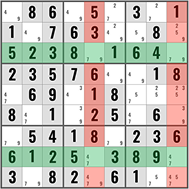
The Unique Rectangle (UR) is an advanced Sudoku technique that exploits a fundamental rule: every valid Sudoku puzzle has exactly one solution. If a pattern of candidates would allow two valid solutions (a “deadly pattern”), we know that pattern can’t occur — and we can use that knowledge to eliminate candidates. The Unique Rectangle is one of the most powerful and frequently used advanced techniques, especially in Evil difficulty puzzles.
Prerequisites
Before learning Unique Rectangles, you should be comfortable with:
- Candidate notation (pencil marks) — complete candidates in every cell
- Naked singles and hidden singles — foundational solving
- Naked pairs and hidden pairs — understanding of subsets
- The concept of puzzle uniqueness — every valid Sudoku has exactly one solution
What is a Deadly Pattern?
A deadly pattern is an arrangement of candidates that would allow two different valid solutions. Consider four cells forming a rectangle:
| Col A | Col B | |
|---|---|---|
| Row 1 | {1,2} | {1,2} |
| Row 2 | {1,2} | {1,2} |
If these four cells are in two different boxes and each cell contains only the candidates {1,2}, there would be two ways to fill them:
- Solution A: R1CA=1, R1CB=2, R2CA=2, R2CB=1
- Solution B: R1CA=2, R1CB=1, R2CA=1, R2CB=2
Both would be valid — which means the puzzle would have two solutions. Since a proper Sudoku has exactly one solution, this pattern cannot exist in a completed puzzle. The Unique Rectangle technique uses this logic to eliminate candidates.
Important: The four cells must span exactly two boxes. If all four are in the same box, the logic doesn’t apply because row/column constraints would distinguish the solutions.
Unique Rectangle Type 1
Type 1 is the simplest and most common form. Three of the four rectangle cells contain only the two shared candidates, while the fourth cell has one or more extra candidates beyond the pair.
Pattern
| Col A | Col B | |
|---|---|---|
| Row 1 | {1,2} | {1,2} |
| Row 2 | {1,2} | {1,2, 5} |
The three cells with only {1,2} are called floor cells. The cell with extra candidates is the roof cell (R2CB in this example).
Elimination
Remove the shared pair candidates (1 and 2) from the roof cell. The roof cell must contain one of its extra candidates (5 in this case) — otherwise a deadly pattern would form.
Result: R2CB is set to 5 (if 5 was its only extra candidate) or the candidates become {5, …other extras}.
Why It Works
If the roof cell were reduced to only {1,2}, we’d have a deadly pattern — two valid solutions. Since the puzzle has exactly one solution, the roof cell cannot be {1,2}. Therefore, 1 and 2 can be removed from it.
Unique Rectangle Type 2
Type 2 occurs when exactly two of the four rectangle cells (on the same side) share one extra candidate beyond the pair.
Pattern
| Col A | Col B | |
|---|---|---|
| Row 1 | {1,2} | {1,2} |
| Row 2 | {1,2, 3} | {1,2, 3} |
The two roof cells (R2CA and R2CB) both have the same extra candidate (3).
Elimination
Remove the extra candidate (3) from all other cells in any house shared by both roof cells. Since R2CA and R2CB are in the same row, eliminate 3 from all other cells in Row 2.
Why It Works
If candidate 3 were removed from both roof cells, they’d both be {1,2}, creating a deadly pattern. Therefore, at least one of them must contain 3. Since they both have 3 and share a house, 3 acts like a “locked pair” for that house — it must be in one of those two cells.
Unique Rectangle Type 3
Type 3 occurs when the two roof cells have different extra candidates beyond the pair.
Pattern
| Col A | Col B | |
|---|---|---|
| Row 1 | {1,2} | {1,2} |
| Row 2 | {1,2, 3} | {1,2, 4} |
Elimination
The extra candidates (3 and 4) in the roof cells form a virtual naked pair in their shared house (Row 2). Treat {3,4} as if it were a naked pair in that house — eliminate 3 and 4 from all other cells in Row 2.
Why It Works
To avoid the deadly pattern, at least one roof cell must use its extra candidate. The pair can’t both resolve to just {1,2}. The extra candidates (3 and 4) must occupy these cells, forming an effective naked pair that excludes those digits from the rest of the row.
Unique Rectangle Type 4
Type 4 occurs when both roof cells have extra candidates, and one of the pair digits is confined to only the two roof cells in their shared house.
Pattern
| Col A | Col B | |
|---|---|---|
| Row 1 | {1,2} | {1,2} |
| Row 2 | {1,2, 3} | {1,2, 4} |
Additionally, candidate 2 appears only in R2CA and R2CB within Row 2 (a hidden pair relationship).
Elimination
Remove the other pair digit (1) from both roof cells. Since 2 is locked into those two cells within Row 2, the roof cells must between them contain 2. This means the deadly pattern configuration for digit 1 can’t complete — so remove 1 from the roof cells.
Why It Works
Candidate 2 must go in one of the two roof cells (it’s locked in Row 2). This breaks the deadly pattern by ensuring one roof cell takes 2 in a fixed position. The other pair digit (1) can therefore be eliminated from both roof cells.
Summary of All Types
| Type | Floor cells | Roof cells | Action |
|---|---|---|---|
| Type 1 | 3 cells with {A,B} only | 1 cell with {A,B} + extras | Remove A and B from the roof cell |
| Type 2 | 2 cells with {A,B} only | 2 cells with {A,B,C} | Eliminate C from peers of both roof cells |
| Type 3 | 2 cells with {A,B} only | 2 cells with different extras | Treat extras as naked pair; eliminate from row |
| Type 4 | 2 cells with {A,B} only | 2 cells with extras; one digit locked | Remove the other pair digit from roof cells |
How to Find Unique Rectangles
- Scan for cells with only two candidates. These are potential floor cells.
- Check if two such cells are in the same row and same two boxes. They must span two boxes.
- Look at the corresponding cells in another row (same columns) to complete the rectangle.
- Check those cells for the pair digits. If they contain the pair plus extras, you have a UR.
- Determine the type based on how many roof cells there are and what extras they contain.
Tip: Unique Rectangles are easier to spot if you focus on cells with exactly 2-3 candidates. Start from bivalue cells and look for rectangles.
Common Mistakes to Avoid
All four cells in the same box. The rectangle MUST span two boxes. If all four cells are in one box, the deadly pattern argument doesn’t apply.
Forgetting to verify uniqueness. The technique relies on the puzzle having exactly one solution. If you’re working with a puzzle that might have multiple solutions (e.g., a hand-constructed puzzle), Unique Rectangle logic could lead to errors.
Misidentifying the type. Carefully count how many cells are floor vs. roof and what extra candidates the roof cells have. Applying the wrong type leads to incorrect eliminations.
Incomplete pencil marks. Missing candidates can hide the deadly pattern or cause you to misidentify the type.
Confusing floor and roof. The floor cells have ONLY the pair digits. The roof cells have the pair digits PLUS extras. The elimination applies to the roof cells (or their shared house).
When to Look for Unique Rectangles
Unique Rectangles are expert-level techniques — use them after exhausting:
- All naked singles and hidden singles
- Naked pairs and hidden pairs
- Pointing pairs and pointing triples
- Naked triples and hidden triples
- X-Wings and Swordfish
- Skyscrapers and Two-String Kites
On SudokuPulse, all four Unique Rectangle types appear in Evil puzzles, averaging about one application of each type per solve.
Frequently Asked Questions
Does the Unique Rectangle work on all Sudoku puzzles?
Only on puzzles guaranteed to have a single unique solution, which is true of all properly constructed Sudoku puzzles. If a puzzle has multiple solutions, the uniqueness assumption fails and UR logic could produce wrong eliminations.
Which Unique Rectangle type is most common?
Type 1 is by far the most common and easiest to spot. Types 2-4 appear less frequently and are progressively harder to identify.
Can multiple Unique Rectangles appear in the same puzzle?
Yes. Evil puzzles on SudokuPulse often require multiple Unique Rectangle applications — sometimes of different types — to solve.
How is Unique Rectangle different from other elimination techniques?
Most Sudoku techniques use only the constraint that digits 1-9 appear exactly once in each house. The Unique Rectangle is special because it uses the meta-constraint that the puzzle has exactly one solution. This makes it fundamentally different from techniques like X-Wing or naked pairs.
Practice Unique Rectangles
Ready to apply Unique Rectangles? Try our Evil difficulty puzzles where all four types appear regularly.