
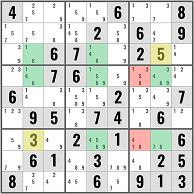
The Swordfish is an advanced Sudoku solving technique that extends the X-Wing pattern from two rows and columns to three. While it appears less frequently than simpler techniques, the Swordfish can break open puzzles that seem impossible to solve by any other means. If you’ve mastered X-Wings and are ready to move to the next level, the Swordfish is the logical next step in your solving toolkit.
Prerequisites
Before learning the Swordfish, you should be comfortable with:
- Candidate notation (pencil marks) — you need to have candidates written in every empty cell
- Naked singles and hidden singles — the foundation of all Sudoku solving
- Naked pairs — understanding how subset elimination works
- X-Wing — the Swordfish is a direct extension of the X-Wing pattern
What is a Swordfish?
A Swordfish occurs when a specific candidate number appears in only two or three cells in each of exactly three rows, and those cells are aligned within exactly three columns (or vice versa — three columns aligning within three rows). This creates a 3×3 grid pattern where the candidate must occupy exactly one cell in each row and column of the pattern, allowing you to eliminate that candidate from all other cells in those three columns (or rows).
How it Relates to the X-Wing
Think of the X-Wing as a “2-Fish” — a candidate constrained to two rows and two columns. The Swordfish is a “3-Fish” — the same logic scaled up:
| Pattern | Rows | Columns | Eliminations from |
|---|---|---|---|
| X-Wing | 2 | 2 | Other cells in the 2 columns |
| Swordfish | 3 | 3 | Other cells in the 3 columns |
| Jellyfish | 4 | 4 | Other cells in the 4 columns |
The family of techniques (X-Wing → Swordfish → Jellyfish) is collectively called Fish patterns.
How to Find a Swordfish: Step-by-Step
Step 1: Pick a Candidate Number
Choose a candidate digit to focus on. Swordfish patterns are easier to spot when you focus on one number at a time. Good candidates to check are digits that appear frequently in pencil marks but have limited positions in some rows.
Step 2: Scan Rows for Limited Positions
Look for three rows where your chosen candidate appears in only two or three columns. Write down which columns each row uses.
Example: Looking for the candidate 4:
- Row 2: 4 appears as a candidate in columns 1, 5, and 8
- Row 5: 4 appears as a candidate in columns 1 and 8
- Row 8: 4 appears as a candidate in columns 5 and 8
The three rows use only columns {1, 5, 8} — exactly three columns. This is a Swordfish!
Step 3: Verify the Pattern
Confirm that:
- You have exactly three rows where the candidate appears
- Across all three rows, the candidate is confined to exactly three columns
- Each row has the candidate in two or three of those columns (not just one)
Important: Not every cell in the 3×3 grid needs to contain the candidate. A Swordfish can have as few as 6 candidate positions (2 per row) or as many as 9 (3 per row). What matters is that all positions fall within the same three columns.
Step 4: Eliminate
Once you’ve confirmed the Swordfish, eliminate the candidate from all other cells in those three columns that are NOT in the three Swordfish rows.
The logic: Since the candidate must be placed exactly once in each of the three rows, and those placements must be spread across the three columns, the candidate in those columns is fully “claimed” by the Swordfish rows.
Worked Example
Let’s walk through a concrete Swordfish on the candidate 7.
After filling in all pencil marks, suppose you notice:
| Col 2 | Col 5 | Col 9 | Other cols | |
|---|---|---|---|---|
| Row 1 | 7 | 7 | no 7s | |
| Row 4 | 7 | 7 | no 7s | |
| Row 7 | 7 | 7 | no 7s |
In these three rows, the candidate 7 only appears in columns 2, 5, and 9. That’s our Swordfish.
What we know:
- Row 1 must place 7 in either Col 2 or Col 9
- Row 4 must place 7 in either Col 2 or Col 5
- Row 7 must place 7 in either Col 5 or Col 9
No matter how you arrange the placements, each column ends up with exactly one 7 from these three rows.
Eliminations: Remove 7 as a candidate from every other cell in columns 2, 5, and 9 — except the cells in rows 1, 4, and 7. For example, if Row 3, Col 5 had 7 as a candidate, you can safely eliminate it.
These eliminations often unlock hidden singles or naked singles in the affected cells, cascade-solving a significant portion of the puzzle.
Column-Based Swordfish
Everything above describes a row-based Swordfish (find rows, eliminate from columns). The pattern works identically in reverse:
- Find three columns where a candidate appears in only two or three cells each
- Check that those cells span exactly three rows
- Eliminate the candidate from other cells in those three rows
The logic is symmetric — always look at it from both directions if you’re stuck.
Common Mistakes to Avoid
Forgetting to check all three rows/columns. A Swordfish requires exactly three defining rows. If the candidate appears in additional rows within those columns, verify those extra rows still have the candidate in other columns too.
Confusing Swordfish with an X-Wing. If only two rows are involved, it’s an X-Wing, not a Swordfish. Count carefully.
Eliminating from the wrong axis. If you found three rows, you eliminate from the columns (and vice versa). A common error is eliminating from both.
Incomplete pencil marks. The Swordfish pattern is invisible without accurate, complete candidate notation. Always double-check your pencil marks before looking for fish patterns.
Expecting a full 3×3 grid. A Swordfish does NOT require all nine intersections to contain the candidate. Many valid Swordfish patterns have “gaps” — cells in the 3×3 intersection that don’t contain the candidate.
When to Look for a Swordfish
The Swordfish is an advanced technique — don’t start looking for it until you’ve exhausted:
- All naked and hidden singles
- Naked pairs and hidden pairs
- Pointing pairs and pointing triples
- Naked triples and hidden triples
- X-Wings
If none of those techniques make progress, scan each digit one at a time for Swordfish patterns. Focus on digits that are mostly solved (6-7 already placed) as the remaining positions are more constrained.
Swordfish vs. X-Wing vs. Jellyfish
| Feature | X-Wing | Swordfish | Jellyfish |
|---|---|---|---|
| Rows involved | 2 | 3 | 4 |
| Columns involved | 2 | 3 | 4 |
| Min candidates needed | 4 | 6 | 8 |
| Difficulty | Advanced | Advanced+ | Expert |
| Frequency | Moderate | Rare | Very rare |
All three are “fish” patterns. Once you understand X-Wing and Swordfish, Jellyfish follows the same logic with four rows and four columns.
Frequently Asked Questions
How rare is a Swordfish in Sudoku?
Swordfish patterns appear primarily in Expert and Evil difficulty puzzles. You’ll rarely need one for Easy, Medium, or Hard puzzles. In competitive solving, recognizing Swordfish quickly is a distinguishing skill between intermediate and advanced solvers.
Can a Swordfish solve the entire puzzle?
By itself, no. But the eliminations from a Swordfish often trigger a cascade of simpler techniques (naked singles, hidden singles) that can solve large portions of the remaining puzzle.
What if I can’t find any Swordfish?
If you’ve checked every digit and found no Swordfish, the puzzle may require even more advanced techniques like XY-Wings, XYZ-Wings, or chains. Consider trying a different approach or verifying your pencil marks are correct.
Is Swordfish the same as “finned Swordfish”?
No. A finned Swordfish is a variant where the basic pattern is almost present, but one extra cell (the “fin”) extends beyond the three columns. Finned Swordfish require additional logic to handle the fin and are considered more advanced.
Practice the Swordfish
Ready to put this technique into action? Try our Expert or Evil difficulty puzzles — these are the levels most likely to require a Swordfish to solve.