
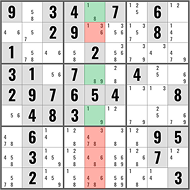
The naked triple is an intermediate Sudoku technique that extends the logic of naked pairs to three cells. While it sounds more complex, the underlying principle is the same: when three cells in a unit collectively contain only three candidates, those candidates can be eliminated from all other cells in the unit. Learning to spot naked triples lets you crack puzzles that pairs alone can’t solve.
Prerequisites
Before learning naked triples, make sure you understand:
- Candidate notation (pencil marks) — accurately listing all possible values in each empty cell
- Naked singles — cells with only one candidate
- Naked pairs — two cells sharing two candidates (the foundation for this technique)
- Hidden singles — a candidate appearing only once in a unit
What is a Naked Triple?
A naked triple exists when three cells within a single unit (row, column, or 3×3 box) collectively contain exactly three candidate numbers — and no others. Those three numbers must be distributed across the three cells in some combination.
The critical rule: Each cell can contain two or three of the candidates, but no cell can contain any candidate outside of the triple. If a cell has even one extra candidate, it’s not part of a naked triple.
Important: Not All Cells Need All Three Candidates
This is the most misunderstood aspect of naked triples. A naked triple does NOT require each cell to contain all three candidates. The cells can have any combination:
| Cell | Candidates | Valid? |
|---|---|---|
| Cell 1 | {2, 5} | Yes — subset of {2, 5, 7} |
| Cell 2 | {2, 7} | Yes — subset of {2, 5, 7} |
| Cell 3 | {5, 7} | Yes — subset of {2, 5, 7} |
This forms a valid naked triple of {2, 5, 7} even though no single cell contains all three candidates. Each cell contains a subset of the triple.
Other valid combinations include:
- {2, 5, 7}, {2, 5}, {5, 7} — one cell has all three
- {2, 5, 7}, {2, 5, 7}, {2, 7} — two cells have all three
- {2, 5, 7}, {2, 5, 7}, {2, 5, 7} — all three have all three
How to Find Naked Triples: Step-by-Step
Step 1: Scan for Cells with 2-3 Candidates
Within a unit, look for cells that have only two or three pencil marks. Cells with four or more candidates are too “crowded” to be part of a naked triple.
Step 2: Check If Three Cells Share Only Three Distinct Candidates
Take any combination of three cells with 2-3 candidates each. Count the total distinct candidates across all three cells.
- If the total is exactly 3 distinct candidates → naked triple found
- If the total is 4 or more → not a naked triple
Step 3: Eliminate from Other Cells
Once you’ve confirmed a naked triple, eliminate all three candidates from every other cell in the same unit. The three triple cells are “claiming” those three numbers.
Worked Example 1: Naked Triple in a Row
Row 3 has these candidates in its empty cells:
| Position | Col 1 | Col 2 | Col 4 | Col 5 | Col 7 | Col 9 |
|---|---|---|---|---|---|---|
| Candidates | 1, 4 | 3, 4, 7, 9 | 1, 4, 8 | 3, 7, 9 | 1, 8 | 3, 7 |
Look at cells in Col 1, Col 4, and Col 7:
- Col 1: {1, 4}
- Col 4: {1, 4, 8}
- Col 7: {1, 8}
Distinct candidates: {1, 4, 8} — exactly three candidates across three cells. Naked triple found!
Eliminations: Remove 1, 4, and 8 from all other cells in Row 3:
- Col 2: {3, 4, 7, 9} → {3, 7, 9} (4 removed)
- Col 5: {3, 7, 9} → {3, 7, 9} (no 1, 4, or 8 present — no change)
- Col 9: {3, 7} → {3, 7} (no change)
The elimination of 4 from Col 2 reduced its candidates. Check if this creates a hidden single or further pair in the row.
Worked Example 2: Naked Triple in a Box
Consider the center 3×3 box (Box 5):
| Col 4 | Col 5 | Col 6 | |
|---|---|---|---|
| Row 4 | 6 (given) | 3, 9 | 1, 3, 5, 9 |
| Row 5 | 3, 5 | 7 (given) | 1, 3, 5 |
| Row 6 | 2, 8 | 5, 9 | 4 (given) |
Look at the cells (Row 4, Col 5), (Row 5, Col 4), and (Row 6, Col 5):
- Row 4, Col 5: {3, 9}
- Row 5, Col 4: {3, 5}
- Row 6, Col 5: {5, 9}
Distinct candidates: {3, 5, 9} — exactly three. Naked triple!
Eliminations: Remove 3, 5, and 9 from other cells in Box 5:
- Row 4, Col 6: {1, 3, 5, 9} → {1} — naked single! Place 1.
- Row 5, Col 6: {1, 3, 5} → { } — wait, that removes everything!
If eliminating leaves a cell empty, you’ve made an error in your pencil marks (or this isn’t actually a valid naked triple). This is a sign to double-check your candidate notation before proceeding.
In a correct scenario, the elimination would leave Row 5, Col 6 with at least one remaining candidate:
- If Row 5, Col 6 was actually {1, 3, 5, 8}: → {1, 8} after elimination
The cascade continues — placing 1 in Row 4, Col 6 triggers further eliminations.
Naked Triple vs. Hidden Triple
| Feature | Naked Triple | Hidden Triple |
|---|---|---|
| What you look for | 3 cells containing only 3 candidates | 3 candidates appearing only in 3 cells |
| What you eliminate | Those candidates from other cells | Other candidates from those 3 cells |
| How to spot | Examine cell contents | Count candidate frequencies |
| Difficulty | Moderate | Hard |
Both reduce the puzzle by the same amount when they overlap. If you find a naked triple, the complement is always a hidden subset somewhere (and vice versa). However, naked triples are generally easier to spot because you’re looking at what’s in each cell rather than tracking where each candidate appears.
Common Mistakes to Avoid
Including a cell with an extra candidate. If one of your three cells has a candidate outside the triple (e.g., a cell has {2, 5, 7, 9} in a supposed {2, 5, 7} triple), it’s NOT a naked triple. All candidates in each cell must be from the triple’s set.
Confusing naked triples with hidden triples. With a naked triple, you eliminate the triple’s candidates from other cells. With a hidden triple, you eliminate other candidates from the triple’s cells. Mixing these up breaks the puzzle.
Not counting distinct candidates correctly. Take your time counting. If three cells have {1,3}, {3,5}, and {1,5,7}, the distinct candidates are {1, 3, 5, 7} — four candidates, not three. This is NOT a naked triple.
Overlooking bi-value cells in the triple. Remember that cells with only two candidates can be part of a naked triple. Don’t skip cells just because they only have two pencil marks.
Forgetting to re-scan after eliminations. Naked triple eliminations often create naked singles, hidden singles, or naked pairs. Always re-check the affected unit immediately.
Tips for Spotting Naked Triples
- Start with bi-value cells. Cells with exactly two candidates are the easiest starting point. If you find two bi-value cells in a unit, check if adding a third cell (with 2 or 3 candidates) completes a naked triple.
- Use the “three distinct candidates” test. When you spot a group of 2-3 candidate cells, quickly count the total distinct digits. If it’s three, you have a naked triple.
- Check boxes before rows and columns. The nine cells of a box are visually compact, making triples easier to identify at a glance.
- Look after solving naked pairs. Naked pair eliminations sometimes reduce nearby cells to 2-3 candidates, creating naked triple opportunities.
When to Use Naked Triples
Naked triples sit at the intermediate level:
- First: Naked singles and hidden singles
- Then: Pointing pairs and pointing triples
- Then: Naked pairs and hidden pairs
- Then: Naked triples and hidden triples
- Later: X-Wings, Swordfish, and wing techniques
Naked triples appear regularly in Hard puzzles and are essential for Expert and Evil difficulty levels.
Frequently Asked Questions
How rare are naked triples?
Moderately common. Most Hard and Expert puzzles contain at least one opportunity for a naked triple. They’re less common than naked pairs but much more common than advanced techniques like X-Wings or Swordfish.
Can a naked triple have cells with only one candidate?
No — a cell with only one candidate is a naked single. The minimum for a naked triple cell is two candidates (which must be a subset of the triple’s three candidates).
What’s the difference between a naked triple and a “locked triple”?
“Locked triple” usually refers to a naked triple that occurs within a box AND is aligned along a row or column. This combines the triple elimination with pointing-style elimination for extra power. It’s a special case, not a separate technique.
Do I need to check every combination of three cells?
In theory, yes — but in practice, focus on cells with only 2-3 candidates. Cells with 4+ candidates can’t be part of a naked triple. This dramatically reduces the combinations you need to check.
Is a naked quad the same logic with four cells?
Yes — a naked quad involves four cells containing only four distinct candidates. The logic extends identically. Naked quads are rare and hard to spot, but the elimination principle is the same.
Practice Naked Triples
Test your naked triple skills on our Hard or Expert puzzles. Look for groups of 2-3 candidate cells and check if three of them share exactly three digits.