
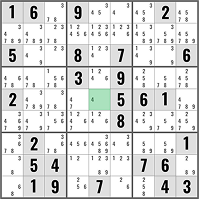
The naked single (also called “sole candidate” or “forced cell”) is the most fundamental Sudoku solving technique. It’s the first technique every solver learns, and it remains the most frequently used method at every difficulty level. If you’re new to Sudoku, mastering naked singles is your essential first step.
What is a Naked Single?
A naked single occurs when an empty cell has only one possible candidate remaining. After checking which numbers already appear in the cell’s row, column, and 3×3 box, if only one number is left, that number must go in that cell. There’s no other option — the placement is forced.
Why It’s Called “Naked”
The term “naked” means the candidate is fully exposed — there’s nothing hiding it. The cell has been stripped of all other possibilities, leaving one number standing alone. Compare this to a hidden single, where the single is “hidden” among other candidates in the cell but is the only place for that number in the unit.
How Naked Singles Work
Every cell in a Sudoku puzzle must satisfy three constraints simultaneously:
- Row constraint: The cell’s value can’t repeat any number already in its row
- Column constraint: The cell’s value can’t repeat any number in its column
- Box constraint: The cell’s value can’t repeat any number in its 3×3 box
When you check all three constraints and only one number from 1–9 hasn’t been used in any of these three groups, that number is a naked single.
The Math Behind It
A cell interacts with its row (8 cells), column (8 cells), and box (8 cells) — but some of these overlap. In total, each cell “sees” exactly 20 other cells (the union of its row, column, and box minus the cell itself). If those 20 cells collectively contain 8 of the 9 possible digits, the remaining digit is the naked single.
How to Find Naked Singles: Step-by-Step
Method 1: Direct Scanning (No Pencil Marks)
This method works well at the beginning of a puzzle when many cells are given:
- Pick an empty cell
- Check the row — note which numbers from 1–9 are already present
- Check the column — note additional numbers
- Check the box — note additional numbers
- Count remaining candidates — if only one number from 1–9 isn’t accounted for, place it
Example: Looking at an empty cell in Row 3, Col 5:
- Row 3 contains: 1, 3, 4, 7, 9
- Col 5 contains: 2, 5, 8
- Box (top-center) contains: 1, 5, 6, 8
Combined, the numbers {1, 2, 3, 4, 5, 6, 7, 8, 9} minus {1, 2, 3, 4, 5, 6, 7, 8, 9} = all nine digits are used — but wait, let me count: {1, 2, 3, 4, 5, 6, 7, 8, 9}. The cell sees all numbers except… let me be specific:
From row: 1, 3, 4, 7, 9 (missing 2, 5, 6, 8) From column: 2, 5, 8 (cuts it to missing just 6) From box: 6 is in the box
Actually, if 6 is also accounted for from the box, then no candidates remain — which means we made an error. In a valid puzzle:
- Row 3 contains: 1, 3, 4, 7, 9
- Col 5 contains: 2, 5, 8
- Box contains: 3, 8
Union of seen digits: {1, 2, 3, 4, 5, 7, 8, 9}. Missing: 6. Place 6 in Row 3, Col 5.
Method 2: Pencil Mark Scanning
Once you’ve written candidates in every empty cell:
- Scan the grid for cells with only one pencil mark
- Place that number immediately
- Update surrounding cells — remove the placed number from candidates in the same row, column, and box
- Re-scan — the update might create new naked singles
This method is faster in the middle and late stages of solving when many cells have been reduced through elimination.
Worked Example: Cascade of Naked Singles
One of the most satisfying aspects of naked singles is their tendency to cascade — solving one naked single immediately creates others.
Suppose you have this scenario in a partially solved puzzle:
Step 1: Cell (Row 2, Col 8) has only candidate {4} → place 4
Step 2: Placing 4 removes it from the candidate lists of cells in Row 2, Col 8, and Box 3. Cell (Row 1, Col 9) in the same box previously had candidates {4, 7}. After removing 4, it becomes {7} → another naked single! Place 7.
Step 3: Placing 7 removes it from its row and column. Cell (Row 1, Col 2) had candidates {3, 7}. After removing 7, it becomes {3} → place 3.
Step 4: Placing 3 triggers yet another naked single in (Row 3, Col 1) …
This cascade can solve 5–10 cells in rapid succession, and it’s a common pattern in Easy and Medium puzzles.
Naked Single vs. Hidden Single
These two beginner techniques are often confused. Here’s the key difference:
| Feature | Naked Single | Hidden Single |
|---|---|---|
| What you check | All candidates for one cell | All positions for one number in a unit |
| How you find it | Cell has only 1 candidate left | Number can only go in 1 cell within a row/col/box |
| Perspective | Cell-focused | Number-focused |
| Which is easier | Depends on the solver | Depends on the solver |
Example of a hidden single: In a row, the number 3 can only go in one cell — even though that cell has candidates {3, 5, 8}. It’s a hidden single for 3. The cell has three candidates (so it’s NOT a naked single), but 3 has nowhere else to go in the row.
Both techniques should be used together. In practice, most solvers alternate between naked single scanning and hidden single scanning.
Common Mistakes to Avoid
Forgetting to check all three constraints. New solvers sometimes check the row and column but forget the 3×3 box (or vice versa). All three must be checked — failing to check one can lead to placing a wrong number.
Not updating candidates after placement. Every time you place a digit, update the pencil marks in all cells in the same row, column, and box. Skipping this step means you’ll miss subsequent naked singles.
Miscounting available digits. With 9 possible digits, it’s easy to lose track. Some solvers use a mental checklist: “1… in the row. 2… in the column. 3… no. 3 is missing. 4…” Work methodically to avoid errors.
Giving up too early. If you don’t immediately see a naked single, don’t assume there aren’t any. Check every empty cell — especially cells at the intersection of a dense row, a dense column, and a dense box.
Tips for Finding Naked Singles Faster
- Focus on dense areas. Look in rows, columns, and boxes that already have 6-7 numbers filled. These have the fewest remaining candidates and are most likely to produce naked singles.
- Start with the given digits. At the very beginning of a puzzle, scan cells adjacent to the given numbers — they have the most constraints and are the best candidates for naked singles.
- Scan systematically. Rather than jumping randomly around the grid, scan row by row or box by box. This prevents missing obvious naked singles.
- Use pencil marks early. Once direct scanning stops producing results, switch to pencil marks. Naked singles become trivially easy to spot when they’re the only pencil mark in a cell.
- Check after every placement. Each placed digit creates new constraints that can immediately produce more naked singles. Always re-check the affected row, column, and box.
When to Use Naked Singles
Naked singles are used constantly at every stage of every puzzle:
- Opening: Combined with given-digit scanning, naked singles are often the first placements you make
- Mid-game: After applying pair or pointing techniques, the resulting eliminations often create naked singles
- End-game: The final placements in a puzzle are almost always naked singles as the grid becomes nearly complete
There is never a wrong time to look for naked singles. They should be your default technique — check for them between every other technique application.
Frequently Asked Questions
Is a naked single the same as “last remaining candidate”?
Yes. Different communities use different names: naked single, sole candidate, forced cell, last remaining candidate, and simply “singles.” They all refer to the same thing — a cell with only one possible value.
Can a puzzle be solved entirely with naked singles?
Very Easy puzzles can sometimes be solved with naked singles alone, but most puzzles also require hidden singles at minimum. Easy puzzles typically need both types of singles. Medium and harder puzzles require additional techniques.
How many naked singles should I check before moving to other techniques?
Make a full pass through the grid (all 81 cells) looking for naked singles. Once a pass finds zero new singles, switch to hidden single scanning or other techniques. After applying those techniques, return to naked single scanning (since eliminations might have created new singles).
Are naked singles easy for computers but hard for humans?
Actually, naked singles are one of the easiest techniques for both humans and computers. The challenge for humans is just the patience to methodically check every cell. Computers check all cells instantly, which is why even basic Sudoku solvers start with naked single passes.
What if I’m stuck and can’t find any naked singles?
If no more naked singles exist, it’s time to move to other techniques, starting with hidden singles. If you’re using pencil marks, look for cells with 2 candidates — those might be part of naked pairs or other subset techniques.
Practice Naked Singles
Naked singles are the foundation of all Sudoku solving. Start with our Easy puzzles to build confidence, then work up to Medium where you’ll combine naked singles with other techniques.