
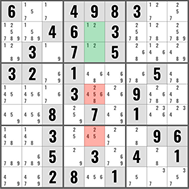
The Naked Quad (also called a Naked Quadruple) is an intermediate Sudoku technique that extends the logic of naked pairs and naked triples to four cells. When four cells in a house collectively contain only four candidate digits, those four digits can be eliminated from all other cells in the house. While less common than naked pairs and triples, the Naked Quad can break open puzzles where smaller subsets don’t appear.
Prerequisites
Before learning the Naked Quad, you should be comfortable with:
- Candidate notation (pencil marks) — complete candidates in every cell
- Naked singles — the simplest subset (one cell, one candidate)
- Naked pairs — two cells sharing two candidates
- Naked triples — three cells sharing three candidates
What is a Naked Quad?
A Naked Quad is a group of four cells in the same house (row, column, or box) where the combined candidates across all four cells are exactly four digits. Each individual cell contains a subset of those four digits (two, three, or four of them).
Since those four digits must go into those four cells, they can be removed from all other cells in the house.
The Naked Subset Family
| Subset | Cells | Candidates | Difficulty |
|---|---|---|---|
| Naked Single | 1 | 1 | Easy |
| Naked Pair | 2 | 2 | Intermediate |
| Naked Triple | 3 | 3 | Intermediate |
| Naked Quad | 4 | 4 | Intermediate-Hard |
Important: Not every cell needs to contain all four candidates. A valid Naked Quad might have cells containing {1,2}, {2,3}, {3,4}, and {1,4} — the union is {1,2,3,4}.
How to Find a Naked Quad: Step-by-Step
Step 1: Scan a House
Choose a row, column, or box and examine all cells with multiple candidates.
Step 2: Group Cells by Candidate Overlap
Look for four cells whose combined candidates span exactly four digits. This is harder to spot than pairs or triples because the combinations are more numerous.
Step 3: Verify
Confirm that:
- You have exactly four cells
- The union of all their candidates is exactly four digits
- Each cell contains only candidates from those four digits
- At least one other cell in the house contains one of the four digits (otherwise there’s nothing to eliminate)
Step 4: Eliminate
Remove the four digits from all other cells in the house.
Worked Example
Consider Row 5 with these candidates:
| Cell | R5C1 | R5C2 | R5C3 | R5C4 | R5C5 | R5C6 | R5C7 | R5C8 | R5C9 |
|---|---|---|---|---|---|---|---|---|---|
| Candidates | {1,3} | 7 | {2,5,8} | {1,4} | {3,4} | {1,3,4} | 6 | {2,5} | 9 |
Look at R5C1, R5C4, R5C5, and R5C6:
- R5C1: {1, 3}
- R5C4: {1, 4}
- R5C5: {3, 4}
- R5C6: {1, 3, 4}
The union of candidates: {1, 3, 4} — wait, that’s only three digits across four cells. That’s actually a hidden single situation. Let me adjust:
Consider Row 3:
| Cell | R3C1 | R3C2 | R3C3 | R3C4 | R3C5 | R3C6 | R3C7 | R3C8 | R3C9 |
|---|---|---|---|---|---|---|---|---|---|
| Candidates | {1,2,4} | 5 | {2,3} | {1,2,3,4} | {3,6,7} | 8 | {1,4} | {6,7} | 9 |
Look at R3C1, R3C3, R3C4, and R3C7:
- R3C1: {1, 2, 4}
- R3C3: {2, 3}
- R3C4: {1, 2, 3, 4}
- R3C7: {1, 4}
The union: {1, 2, 3, 4} — exactly four digits across four cells. This is a Naked Quad!
Elimination: Remove 1, 2, 3, and 4 from all other cells in Row 3. In this case:
- R3C5 has {3, 6, 7} → remove 3 → becomes {6, 7}
Common Mistakes to Avoid
Expecting all four candidates in every cell. A Naked Quad can include cells with only two or three of the four digits. What matters is that the union is exactly four digits.
Confusing with a hidden quad. In a Naked Quad, the four cells contain ONLY the four digits. In a Hidden Quad, the cells may contain other candidates too — the four digits just don’t appear elsewhere in the house.
Counting wrong. With four cells, there are many possible combinations. Be systematic — check candidate counts carefully.
Looking only at pairs. If three cells share three digits, that’s a naked triple. You need exactly FOUR cells with FOUR combined digits for a quad.
Missing quads because they’re “big.” Quads are harder to spot visually than pairs or triples. Consider checking programmatically (our solver can identify them).
When to Look for a Naked Quad
Naked Quads are intermediate-hard techniques — use them after:
- All naked singles and hidden singles
- Naked pairs and hidden pairs
- Naked triples and hidden triples
- Pointing pairs and pointing triples
If none of those techniques produce progress, systematically scan each house for four-cell subsets.
Naked Quad vs. Hidden Quad
| Feature | Naked Quad | Hidden Quad |
|---|---|---|
| Cell candidates | Only the four digits | Four digits plus other candidates |
| What’s “naked/hidden” | The four cells are obvious | The four digits are hidden among other candidates |
| Elimination | Remove four digits from other cells in house | Remove other candidates from the four cells |
| Spotting difficulty | Moderate | Hard |
In practice, if you can spot the complement, a Naked Quad in a house with 5 empty cells is equivalent to a Hidden Single in the remaining cell.
Frequently Asked Questions
How common are Naked Quads?
Naked Quads are uncommon. Most puzzles can be solved without them. They appear occasionally in Hard and Expert puzzles when pairs and triples don’t produce enough progress.
Is a Naked Quad just a bigger Naked Triple?
Yes, conceptually. The same subset logic applies — N cells with N combined candidates in a house. The Naked Quad is the N=4 case.
Can there be a Naked “Quintuple” or larger?
In a standard 9×9 Sudoku, subsets larger than 4 are possible but extremely rare. In practice, a 5-cell subset is more easily identified as the complementary 4-cell hidden subset.
Do I need to find Naked Quads to solve most puzzles?
No. Most puzzles up to Hard difficulty can be solved without Naked Quads. They’re a useful tool for Expert puzzles when simpler subsets aren’t available.
Practice Naked Quads
Try our Hard or Expert difficulty puzzles for chances to apply Naked Quads.