
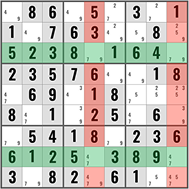
The Jellyfish is the largest of the standard fish patterns in Sudoku, extending the logic of X-Wing (2 rows × 2 columns) and Swordfish (3 × 3) to 4 rows × 4 columns. It’s one of the rarest techniques you’ll encounter, appearing only in the most challenging puzzles. If you’ve mastered X-Wings and Swordfish, the Jellyfish follows the same principle at a larger scale.
Prerequisites
Before learning the Jellyfish, you should be comfortable with:
- Candidate notation (pencil marks) — complete candidates in every cell
- X-Wing — the 2-Fish pattern
- Swordfish — the 3-Fish pattern
- All intermediate techniques (naked pairs, pointing pairs, etc.)
What is a Jellyfish?
A Jellyfish occurs when a candidate appears in at most four cells in each of four rows, and all those positions are confined to exactly four columns. This means the candidate must occupy exactly one position per column across the four rows, so it can be eliminated from all other cells in those four columns.
The Fish Pattern Family
| Pattern | Rows | Columns | Min cells | Max cells |
|---|---|---|---|---|
| X-Wing | 2 | 2 | 4 | 4 |
| Swordfish | 3 | 3 | 6 | 9 |
| Jellyfish | 4 | 4 | 8 | 16 |
All fish patterns follow the same logic: if N rows have a candidate confined to N columns, the candidate can be eliminated from all other cells in those N columns. The Jellyfish is simply the N=4 case.
How to Find a Jellyfish: Step-by-Step
Step 1: Pick a Candidate Number
Choose a digit and focus on it exclusively.
Step 2: Scan for Rows with Limited Positions
Look for rows where your candidate appears in four or fewer columns. You need four such rows.
Step 3: Check Column Overlap
Across all four rows, verify that the candidate positions are confined to exactly four columns. If the positions span five or more columns, there’s no Jellyfish.
Step 4: Eliminate
Remove the candidate from all other cells in those four columns that are NOT in the four Jellyfish rows.
Worked Example
Looking for candidate 2 across the grid:
| Col 1 | Col 3 | Col 6 | Col 9 | |
|---|---|---|---|---|
| Row 1 | 2 | 2 | ||
| Row 3 | 2 | 2 | ||
| Row 5 | 2 | 2 | ||
| Row 8 | 2 | 2 |
- Row 1: 2 in columns 1 and 6
- Row 3: 2 in columns 1 and 3
- Row 5: 2 in columns 3 and 6
- Row 8: 2 in columns 6 and 9
All positions are within columns {1, 3, 6, 9} — exactly four columns. This is a Jellyfish!
Elimination: Remove 2 from all cells in columns 1, 3, 6, and 9 that are NOT in rows 1, 3, 5, or 8. For example, if R2C1, R4C3, R7C6, or R9C9 have 2 as a candidate, eliminate it.
Column-Based Jellyfish
As with all fish patterns, the Jellyfish works symmetrically. You can find four columns where a candidate is confined to four rows, then eliminate from other cells in those four rows.
Common Mistakes to Avoid
Needing exactly four cells per row. Each row can have two, three, or four cells — what matters is that all positions collectively span exactly four columns.
Spanning more than four columns. If the four rows use five or more columns, there’s no Jellyfish. Each additional column breaks the containment.
Confusing with smaller fish. If only two or three rows participate, you might have an X-Wing or Swordfish instead. The Jellyfish specifically requires four rows.
Eliminating from the wrong axis. If you found four rows, eliminate from the columns. If you found four columns, eliminate from the rows.
Incomplete pencil marks. Fish patterns are invisible without complete candidate notation.
When to Look for a Jellyfish
The Jellyfish is one of the rarest standard techniques — use it only after exhausting:
- All basic and intermediate techniques
- X-Wings and Swordfish
- Skyscrapers, Two-String Kites, and other single-digit patterns
- XY-Wings and XYZ-Wings
Jellyfish appear in the most challenging puzzles and are quite rare — most Expert and Evil puzzles don’t require them.
Frequently Asked Questions
How rare is the Jellyfish?
Very rare. Most solvers go through hundreds of puzzles without needing one. The Jellyfish is more of a theoretical completion of the fish pattern family than a commonly used technique.
Is there a fish pattern larger than Jellyfish?
Theoretically, a 5-Fish (“Squirmbag”), 6-Fish (“Whale”), etc., exist. In practice, they’re so rare as to be essentially non-existent in standard 9×9 Sudoku puzzles. Most solvers never encounter anything beyond a Swordfish.
Can I find a Jellyfish without software?
Yes, but it requires patience. Focus on one digit at a time and carefully track which columns each row uses. Most human solvers find Jellyfish by systematically scanning digits that have many unresolved positions.
Does the Jellyfish produce many eliminations?
When it appears, the Jellyfish can produce significant eliminations — up to 20 or more cells can be affected across four columns. This often cascades into many simpler technique applications.
Practice the Jellyfish
For the best chance of encountering a Jellyfish, try our Evil difficulty puzzles.