
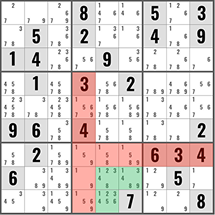
The hidden triple is one of the more challenging subset techniques in Sudoku. While naked triples are relatively straightforward to spot, hidden triples live up to their name — they’re genuinely hidden among other candidates and require careful scanning to identify. Mastering this technique gives you a powerful tool for breaking through puzzles where simpler methods stall.
Prerequisites
Before tackling hidden triples, you should be comfortable with:
- Candidate notation (pencil marks) — complete, accurate candidate lists in every empty cell
- Hidden singles — finding a candidate that appears only once in a unit
- Hidden pairs — the two-candidate version of this technique
- Naked pairs and naked triples — understanding subset elimination
What is a Hidden Triple?
A hidden triple occurs when three candidates appear in exactly three cells within a single unit (row, column, or 3×3 box), even though those three cells may also contain other candidates. The “hidden” part means these three candidates are obscured by additional candidates in the same cells.
Once you identify a hidden triple, you can eliminate all other candidates from those three cells, leaving only the three hidden triple candidates. This is the opposite of a naked triple, where you eliminate the triple’s candidates from other cells.
Hidden Triple vs. Naked Triple
| Feature | Naked Triple | Hidden Triple |
|---|---|---|
| What you find | 3 cells containing only 3 candidates between them | 3 candidates that appear only in 3 cells |
| What you eliminate | Those 3 candidates from other cells in the unit | Other candidates from those 3 cells |
| Visibility | Easier to spot | Harder to spot |
| Effect | Reduces candidates in surrounding cells | Cleans up the 3 cells themselves |
Think of it this way: with a naked triple, the three cells are “naked” — they show you exactly the candidates involved, and nothing else. With a hidden triple, the three candidates are hidden among other candidates in those same cells.
How to Find Hidden Triples: Step-by-Step
Step 1: Choose a Unit to Examine
Pick a row, column, or 3×3 box. Hidden triples can appear in any unit type.
Step 2: Count Candidate Occurrences
For each candidate number (1–9) that hasn’t been placed in the unit yet, count how many cells contain it and note which cells those are.
Example — scanning Row 4:
| Candidate | Appears in cells | Count |
|---|---|---|
| 1 | C, E, G | 3 |
| 3 | A, C, E, F, G | 5 |
| 5 | C, G | 2 |
| 7 | A, C, E | 3 |
| 9 | A, E, F, G | 4 |
Step 3: Look for Three Candidates Sharing Three Cells
Find three candidates whose combined cell positions span exactly three cells.
From our example:
- Candidate 1 appears in cells {C, E, G}
- Candidate 5 appears in cells {C, G} — a subset of {C, E, G}
- Candidate 7 appears in cells {A, C, E} — not quite…
Let’s adjust: suppose instead:
- Candidate 1 appears in cells {C, E, G}
- Candidate 5 appears in cells {C, G}
- Candidate 7 appears in cells {C, E, G}
The union of cells for candidates 1, 5, and 7 is {C, E, G} — exactly three cells! And these three candidates don’t appear in any other cells in the row. This is a hidden triple.
Step 4: Eliminate Other Candidates from Those Cells
Remove every candidate except 1, 5, and 7 from cells C, E, and G.
If cell C had candidates {1, 3, 5, 7, 9}, it becomes {1, 5, 7}. If cell E had candidates {1, 3, 7, 9}, it becomes {1, 7}. If cell G had candidates {1, 3, 5, 9}, it becomes {1, 5}.
These eliminations often transform the puzzle dramatically, revealing naked singles or enabling other techniques.
Worked Example
Let’s walk through a complete example in a row.
Row 6 has these remaining candidates in its empty cells:
| Cell | Position | Candidates |
|---|---|---|
| A | Col 1 | 2, 4, 8 |
| B | Col 3 | 1, 2, 4, 6 |
| C | Col 5 | 2, 3, 4, 6, 9 |
| D | Col 6 | 1, 2, 3, 6, 9 |
| E | Col 8 | 3, 4, 6, 9 |
| F | Col 9 | 1, 2, 4, 8 |
Now count where each candidate appears:
| Candidate | Cells | Count |
|---|---|---|
| 1 | B, D, F | 3 |
| 2 | A, B, C, D, F | 5 |
| 3 | C, D, E | 3 |
| 4 | A, B, C, E, F | 5 |
| 6 | B, C, D, E | 4 |
| 8 | A, F | 2 |
| 9 | C, D, E | 3 |
Focus on candidates 3, 6, and 9:
- 3 appears in {C, D, E}
- 9 appears in {C, D, E}
- 6 appears in {B, C, D, E} — but wait, 6 also appears in B
This would NOT be a hidden triple because 6 appears outside the three cells. Let’s adjust: suppose 6 only appears in {C, D, E} (B doesn’t have 6):
- 3 is in {C, D, E}
- 6 is in {C, D, E}
- 9 is in {C, D, E}
The union is {C, D, E} — exactly three cells. Candidates 3, 6, and 9 form a hidden triple in cells C, D, and E.
Eliminate all non-triple candidates:
- Cell C: {2, 3, 4, 6, 9} → {3, 6, 9}
- Cell D: {1, 2, 3, 6, 9} → {3, 6, 9}
- Cell E: {3, 4, 6, 9} → {3, 6, 9}
By cleaning up these three cells, you’ve reduced the candidate count significantly. Now check the rest of Row 6 — the removal of candidates 2, 4, and 1 from cells C, D, and E might create naked singles or naked pairs in other cells.
Why Hidden Triples are Hard to Spot
Hidden triples are challenging because:
The cells contain extra candidates. Unlike naked triples where the cells only contain the triple’s candidates, hidden triple cells are cluttered with additional numbers. Your eye naturally focuses on what’s in a cell, not on what’s only in a specific set of cells.
You must track candidate positions, not cell contents. Finding hidden triples requires thinking “where does candidate X appear?” rather than “what candidates are in this cell?” This is the opposite of how most solvers naturally scan.
Three is the hardest size. Hidden singles are easy (one candidate, one cell). Hidden pairs (two candidates, two cells) are manageable. Hidden triples require tracking three candidates across three cells — significantly more complex.
Systematic Method for Finding Hidden Triples
If you struggle to spot hidden triples visually, use this systematic approach:
- List all unplaced candidates in the unit
- Record the cell positions for each candidate
- Look for three candidates whose positions union to ≤ 3 cells
- Verify that no other candidates are exclusive to those same three cells
This mechanical approach is slower than visual scanning but guarantees you won’t miss a hidden triple.
Common Mistakes to Avoid
Eliminating the wrong candidates. With a hidden triple, you eliminate other candidates from the triple’s cells — NOT the triple’s candidates from other cells. This is the opposite of naked triples. Getting this backwards breaks the puzzle.
Incorrect cell counting. If one of the three candidates appears in a fourth cell, it’s not a hidden triple. Double-check your pencil marks.
Missing easier techniques first. Hidden triples are rare enough that you should exhaust singles, pairs, and pointing patterns before spending time looking for them. If you find a hidden triple, you’ve probably missed something simpler.
Incomplete pencil marks. Hidden triple detection absolutely requires complete, accurate pencil marks. A missing candidate in your notation can make a hidden triple invisible — or worse, make a false one appear.
When to Look for Hidden Triples
Hidden triples are an advanced technique. Apply them after exhausting:
- Naked singles and hidden singles
- Pointing pairs and pointing triples
- Naked pairs and hidden pairs
- Naked triples
In practice, hidden triples are rare. Many solvers find them less than once per 10 puzzles. When they do appear, they’re almost always in Expert or Evil difficulty puzzles.
Frequently Asked Questions
How rare are hidden triples in Sudoku?
Quite rare compared to hidden pairs or naked triples. Most puzzles at Medium and Hard difficulty never require them. You’ll encounter them mainly in Expert and Evil puzzles, or in puzzles specifically designed to test advanced techniques.
What’s the difference between a hidden triple and a hidden quad?
A hidden quad involves four candidates restricted to four cells. The logic is identical to a hidden triple, just extended by one. Hidden quads are even rarer than hidden triples and extremely difficult to spot visually.
If I find a hidden triple, is the puzzle almost solved?
Not necessarily — but the eliminations from a hidden triple are often substantial. Removing 3–6 candidates from three cells frequently creates naked singles or pairs that cascade through the puzzle. It can be the key breakthrough.
Can hidden triples appear in 3×3 boxes?
Absolutely. Hidden triples can appear in rows, columns, or 3×3 boxes. Boxes are actually where they’re most commonly found because the nine cells of a box are visually grouped, making it slightly easier to track candidate positions.
I found three candidates in three cells, but they also have other candidates. Is that a hidden triple?
Only if those three candidates do NOT appear in any other cells within the same unit. If candidate 3 appears in cells A, B, C AND cell D in the same row, then 3 can’t be part of a hidden triple in cells A, B, C (because it has another possible location). Re-check your candidate positions.
Practice Hidden Triples
Hidden triples appear most often in Expert and Evil puzzles. Challenge yourself with our Expert or Evil difficulty levels and look for hidden triples when you get stuck.