
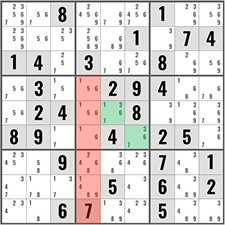
The Hidden Quad (also called a Hidden Quadruple) is an intermediate-to-advanced Sudoku technique. It occurs when four candidate digits are confined to exactly four cells within a house — but those cells also contain other candidates that “hide” the pattern. By identifying the Hidden Quad, you can remove all other candidates from those four cells, often unlocking further progress. Hidden Quads are the complement of Naked Quads and the logical extension of hidden pairs and hidden triples.
Prerequisites
Before learning the Hidden Quad, you should be comfortable with:
- Candidate notation (pencil marks) — complete candidates in every cell
- Hidden singles — one digit confined to one cell
- Hidden pairs — two digits confined to two cells
- Hidden triples — three digits confined to three cells
What is a Hidden Quad?
A Hidden Quad exists when four digits appear as candidates in only four cells within a house (row, column, or box). Those four cells may contain other candidates too — the four digits are “hidden” among them. Since those four digits can only go in those four cells, all other candidates can be removed from those cells.
The Hidden Subset Family
| Subset | Digits | Cells | Difficulty |
|---|---|---|---|
| Hidden Single | 1 | 1 | Easy |
| Hidden Pair | 2 | 2 | Intermediate |
| Hidden Triple | 3 | 3 | Intermediate-Hard |
| Hidden Quad | 4 | 4 | Hard |
How to Find a Hidden Quad: Step-by-Step
Step 1: Pick a House
Choose a row, column, or box to analyze.
Step 2: Check Where Each Digit Can Go
For each candidate digit that hasn’t been placed in the house, note which cells still contain it. You’re looking for four digits that each appear in only a subset of the same four cells.
Step 3: Identify Four Digits in Four Cells
If you find four digits that are collectively confined to exactly four cells — even if those cells contain other candidates — you have a Hidden Quad.
Step 4: Eliminate Extra Candidates
Remove all candidates EXCEPT the four hidden digits from those four cells.
Worked Example
Consider Column 4 with these candidates in its empty cells:
| Cell | Candidates |
|---|---|
| R1C4 | {1, 3, 5, 6, 8} |
| R2C4 | {1, 5, 7} |
| R4C4 | {2, 3, 6, 9} |
| R5C4 | {2, 5, 7, 9} |
| R7C4 | {2, 3, 6} |
| R9C4 | {1, 3, 5, 7} |
Now check where each digit appears:
- 1: R1, R2, R9 (3 cells)
- 2: R4, R5, R7 (3 cells)
- 3: R1, R4, R7, R9 (4 cells)
- 5: R1, R2, R5, R9 (4 cells)
- 6: R1, R4, R7 (3 cells)
- 7: R2, R5, R9 (3 cells)
- 8: R1 (1 cell)
- 9: R4, R5 (2 cells)
Look at digits {2, 6, 3, 9}: where do they appear?
- 2: R4, R5, R7
- 3: R1, R4, R7, R9
- 6: R1, R4, R7
- 9: R4, R5
Hmm, that’s five cells. Let’s try {2, 6, 9} — they appear only in R4, R5, R7. That’s a hidden triple, actually! But let me construct a proper hidden quad example:
Check digits {1, 5, 7, 8}:
- 1: R1, R2, R9
- 5: R1, R2, R5, R9
- 7: R2, R5, R9
- 8: R1
All four digits are confined to cells {R1, R2, R5, R9} — exactly four cells. This is a Hidden Quad!
Elimination: Remove all other candidates from R1C4, R2C4, R5C4, and R9C4:
- R1C4: {1, 3, 5, 6, 8} → {1, 5, 8} (remove 3 and 6)
- R2C4: {1, 5, 7} → {1, 5, 7} (no change — already clean)
- R5C4: {2, 5, 7, 9} → {5, 7} (remove 2 and 9)
- R9C4: {1, 3, 5, 7} → {1, 5, 7} (remove 3)
These removals may create naked pairs or singles in the remaining cells.
Hidden Quad vs. Naked Quad
Hidden Quads and Naked Quads are complements. In a house with 8 empty cells, a Hidden Quad on 4 digits in 4 cells implies a Naked Quad on the other 4 digits in the other 4 cells (and vice versa).
| Feature | Naked Quad | Hidden Quad |
|---|---|---|
| What’s visible | Four cells with only four digits | Four digits found in only four cells |
| Elimination | Remove four digits from other cells | Remove other digits from four cells |
| Easier to spot | When cells have few candidates | When digits have few positions |
In practice, whichever is easier to spot depends on the grid. Often, finding the complement is a useful cross-check.
Common Mistakes to Avoid
Overlooking hidden quads because cells have many candidates. The whole point of a “hidden” quad is that the four digits are buried among other candidates. Don’t dismiss cells with 4-5 candidates.
Confusing with naked quads. In a naked quad, the four cells contain ONLY the four digits. In a hidden quad, the cells contain extra candidates that need to be removed.
Not checking all four digits. You need to verify that ALL four digits are confined to the same four cells. If even one digit appears in a fifth cell, the pattern breaks.
Missing the complement. If you can’t find a hidden quad directly, try looking for the complementary naked subset instead.
When to Look for a Hidden Quad
Hidden Quads are hard techniques — use them after exhausting:
- All naked singles and hidden singles
- Naked pairs and hidden pairs
- Naked triples and hidden triples
- Pointing pairs and pointing triples
Hidden Quads are rare — most puzzles that require a quad are more easily solved by spotting the complementary naked subset.
Frequently Asked Questions
How rare are Hidden Quads?
Very rare. Most solvers rarely encounter a situation where a Hidden Quad is the easiest path forward. The complementary Naked Quad (or smaller subset) is usually more visible.
Is it worth learning Hidden Quads?
Understanding them deepens your grasp of how subset logic works. In practice, you’ll more often use pairs and triples — but knowing quads exist helps you recognize unusual situations.
Can a house have both a Hidden Quad and a Naked Quad?
Yes — they’re complementary. If a house has 8 empty cells and a Hidden Quad covers 4 of them, the other 4 cells form a Naked Quad (and vice versa).
Are there Hidden “Quintuples”?
In a 9-cell house with 9 empty cells, theoretically. In practice, subsets of 5+ are always better identified through their complement (a subset of 4 or fewer).
Practice Hidden Quads
Try our Hard or Expert difficulty puzzles for complex subset situations.