
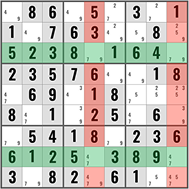
The Empty Rectangle is an advanced single-digit Sudoku technique that exploits the arrangement of a candidate within a box. When a candidate’s positions in a box form a pattern that avoids one corner (creating an “empty rectangle”), this structure can be combined with a strong link outside the box to eliminate candidates. Empty Rectangles appear in Evil difficulty puzzles on SudokuPulse, averaging about 2 applications per solve.
Prerequisites
Before learning Empty Rectangles, you should be comfortable with:
- Candidate notation (pencil marks) — complete candidates in every cell
- Naked singles and hidden singles — foundational solving
- Pointing pairs — understanding how box-line interactions work
- Strong links / conjugate pairs — when a candidate appears in exactly two cells in a house
- X-Wing and Skyscraper — related single-digit patterns
What is an Empty Rectangle?
An empty rectangle exists in a box when a candidate’s positions within that box completely avoid one row-column intersection. In other words, the candidate appears in an L-shape or T-shape within the box — there’s at least one row and one column within the box where the candidate is present, but the intersection of one particular row and column within the box is empty.
The “empty rectangle” itself is the 2×2 corner of the box where the candidate does NOT appear.
The Key Insight
When a candidate forms an empty rectangle in a box, the candidate must appear in one of the two “arms” of the pattern. If a strong link (conjugate pair) on the same digit exists in a row or column that passes through one arm, the elimination from the strong link can propagate through the box to eliminate the candidate from cells in the other arm’s line.
How to Find an Empty Rectangle: Step-by-Step
Step 1: Pick a Candidate Number
Focus on one digit at a time.
Step 2: Find a Box with an Empty Rectangle
Look for a box where the candidate appears in an L-shaped or T-shaped pattern. Specifically, there should be a 2×2 region within the box (two rows × two columns) where the candidate is completely absent.
Example for digit 5 in Box 5 (rows 4-6, columns 4-6):
| Col 4 | Col 5 | Col 6 | |
|---|---|---|---|
| Row 4 | 5 | ||
| Row 5 | 5 | 5 | |
| Row 6 | 5 |
The candidate 5 is absent from {R4C4, R4C6, R6C4, R6C6} — but this forms an X, not an empty rectangle. Let’s try a better example:
| Col 4 | Col 5 | Col 6 | |
|---|---|---|---|
| Row 4 | 5 | 5 | |
| Row 5 | 5 | ||
| Row 6 |
Here, the candidate 5 is absent from rows 5-6 in columns 4-5. The “empty rectangle” is the bottom-left 2×2 corner. The candidate forms an L-shape in the top-right.
Step 3: Find a Strong Link
Look for a conjugate pair on dig 5 in a column that passes through the box’s occupied row, or a row that passes through the box’s occupied column.
For our example, suppose column 6 has digit 5 in exactly two cells in some other part of the grid: R4C6 (inside the box) and R9C6 (outside the box). That’s a strong link in column 6.
Step 4: Make the Elimination
The strong link in column 6 connects to row 4 of our box. The other arm of the empty rectangle extends through column 5 (where 5 also appears in the box). So we can eliminate 5 from the cell at the intersection of row 9 (the other end of the strong link) and column 5 (the other arm of the rectangle).
Eliminate 5 from R9C5 (if it has 5 as a candidate).
Why It Works
The logic follows a chain:
- If R9C6 = 5, then R4C6 ≠ 5 (strong link). Within the box, 5 must be in column 5 (the other arm).
- If R9C6 ≠ 5, then the strong link forces something elsewhere, but the net effect is the same.
No matter which end of the strong link is true, the candidate at the intersection of the opposite strong-link line and the empty rectangle’s other arm is eliminated.
Common Mistakes to Avoid
No true empty rectangle. The candidate’s positions in the box must form a pattern with a clear 2×2 empty corner. If the candidate is scattered across all three rows and columns of the box, there’s no empty rectangle.
Missing the strong link. The conjugate pair must exist in a line that passes through the box. Without it, the pattern can’t produce an elimination.
Wrong elimination target. The elimination happens at the intersection of the other arm’s line and the strong link’s other endpoint’s line. Be precise about which cell is targeted.
Confusing with pointing pairs. If the candidate is restricted to one row or column within the box, that’s a pointing pair/triple — simpler than an empty rectangle. Empty rectangles involve an L or T shape.
Incomplete pencil marks. Empty Rectangles require accurate candidates to identify both the box pattern and the strong link.
When to Look for an Empty Rectangle
Empty Rectangles are expert/evil-level techniques — use them after exhausting:
- All naked singles and hidden singles
- Naked pairs and hidden pairs
- Pointing pairs and pointing triples
- Naked triples and hidden triples
- X-Wings and Swordfish
- Skyscrapers and Two-String Kites
Empty Rectangle vs. Related Techniques
| Feature | Pointing Pair | X-Wing | Skyscraper | Empty Rectangle |
|---|---|---|---|---|
| Box involvement | Candidate in one line of box | No box role | No box role | Candidate in L/T shape in box |
| Lines involved | 1 row/col | 2 rows + 2 cols | 2 rows + 1 shared col | 1 strong link + box |
| Complexity | Intermediate | Advanced | Advanced | Advanced-Expert |
Frequently Asked Questions
How common are Empty Rectangles?
Empty Rectangles appear primarily in Evil difficulty puzzles. On SudokuPulse, they average about 2 applications per Evil puzzle. They’re less common than W-Wings but more common than techniques like ALS or chains.
Can Empty Rectangles work with boxes at the edge of the grid?
Yes. The box can be any of the nine boxes. The strong link connects from outside the box to the box’s candidate pattern.
Is the Empty Rectangle the same as a “Single Digit Pattern”?
The Empty Rectangle is one of several single-digit patterns, alongside Skyscrapers, Two-String Kites, and X-Wings. All these techniques focus on one digit at a time.
What if I can’t find any Empty Rectangles?
Try other advanced techniques like W-Wings, Unique Rectangles, XY-Wings, or chains. Verify your pencil marks are complete.
Practice Empty Rectangles
Try our Evil difficulty puzzles to encounter Empty Rectangles in real solving.