
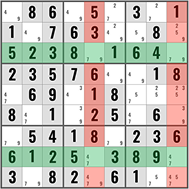
Simple Coloring (also called Single-Digit Coloring or Conjugate Pair Chains) is an advanced Sudoku technique that works on one digit at a time. By tracing chains of strong links (conjugate pairs) and assigning alternating colors to cells, you can identify contradictions or make eliminations. Simple Coloring is the foundation for more complex chain techniques and can solve situations where fish patterns and wings fail.
Prerequisites
Before learning Simple Coloring, you should be comfortable with:
- Candidate notation (pencil marks) — complete candidates in every cell
- Strong links / conjugate pairs — when a candidate appears in exactly two cells in a house
- X-Wing and Skyscraper — simpler single-digit patterns
- All intermediate techniques
What is Simple Coloring?
Simple Coloring is based on conjugate pairs for a single digit. A conjugate pair exists when a candidate appears in exactly two cells in a house — if one cell has the digit, the other doesn’t, and vice versa. This is a strong link.
By chaining these strong links together, you create a network where cells alternate between two states: either the digit IS in this cell or it ISN’T. We represent these two states with two colors (e.g., blue and green).
The Two Rules
After coloring a chain, you can apply two types of logic:
Rule 1 — Color Trap (Elimination): If an uncolored cell can see a blue cell AND a green cell, the candidate can be eliminated from that uncolored cell. Why? One of the two colors must be true (contain the digit). The uncolored cell sees both, so it can’t have the digit regardless of which color is true.
Rule 2 — Color Wrap (Contradiction): If two cells of the SAME color can see each other (share a house), that color must be entirely false. The other color is true. All cells of the false color have the candidate removed; all cells of the true color are set to that digit.
How to Use Simple Coloring: Step-by-Step
Step 1: Choose a Digit
Pick a candidate number to analyze. Good candidates are digits that have many conjugate pairs across the grid.
Step 2: Find All Conjugate Pairs
For your chosen digit, identify every house (row, column, or box) where the digit appears in exactly two cells. Each is a strong link.
Step 3: Build the Color Chain
Start at any cell in a conjugate pair. Color it blue. Color the other cell in the pair green. If the green cell forms another conjugate pair in a different house, color the next cell blue — and so on, alternating colors.
Continue until no more cells can be added to the chain.
Step 4: Look for Rule 1 (Color Trap)
Check each uncolored cell that has the candidate. Can it see cells of BOTH colors? If yes, eliminate the candidate from it.
Step 5: Look for Rule 2 (Color Wrap)
Check if any two cells of the SAME color share a house. If yes, that entire color is false.
Worked Example: Color Trap (Rule 1)
Analyzing candidate 4 across the grid. After finding conjugate pairs:
Chain building:
- Row 2: 4 in R2C1 and R2C7 only → Color R2C1 = blue, R2C7 = green
- Column 1: 4 in R2C1 and R8C1 only → R2C1 is blue, so R8C1 = green
- Row 8: 4 in R8C1 and R8C5 only → R8C1 is green, so R8C5 = blue
- Column 7: 4 in R2C7 and R6C7 only → R2C7 is green, so R6C7 = blue
The chain:
- Blue: R2C1, R8C5, R6C7
- Green: R2C7, R8C1
Now check uncolored cells containing 4. Suppose R6C5 has a 4 candidate:
- R6C5 sees R6C7 (blue, same row)
- R6C5 sees R8C5 (blue, same column)
Wait — it sees two blue cells but no green cells. No trap here.
Suppose R2C5 has a 4 candidate:
- R2C5 sees R2C1 (blue, same row) and R2C7 (green, same row)
- R2C5 also sees R8C5 (blue, same column)
R2C5 sees both blue AND green → eliminate 4 from R2C5 (Color Trap).
Worked Example: Color Wrap (Rule 2)
Using the same chain, suppose instead of the above, R8C1 and R8C5 were both in the green color group AND they share Row 8. Two green cells in the same row means green is false.
Result: Remove 4 from all green cells. Set all blue cells to 4.
Common Mistakes to Avoid
Using weak links instead of strong links. Simple Coloring requires strong links only — the digit must appear in EXACTLY two cells in the house. If it appears in three or more, it’s not a valid link for coloring.
Mixing up color assignments. Keep your coloring consistent. Each strong link alternates colors. If you make an error in one assignment, the entire chain becomes unreliable.
Forgetting to check all uncolored cells. The color trap works for ANY uncolored cell that sees both colors, not just cells adjacent to the chain.
Not checking for color wraps first. A color wrap (Rule 2) is more powerful than a color trap — it resolves ALL cells in the chain. Check for wraps before traps.
Applying to multiple digits at once. Simple Coloring works on ONE digit at a time. Multi-digit coloring is a different, more advanced technique.
When to Use Simple Coloring
Simple Coloring is an advanced technique — use it after exhausting:
- All basic and intermediate techniques
- X-Wings, Swordfish, and other fish patterns
- Skyscrapers and Two-String Kites
- XY-Wings and XYZ-Wings
In fact, Skyscrapers and Two-String Kites are specific cases of Simple Coloring with just two strong links. Simple Coloring generalizes to chains of any length.
Simple Coloring vs. Related Techniques
| Feature | Skyscraper | Simple Coloring | Chains (AIC) |
|---|---|---|---|
| Digits | One | One | Multiple |
| Link types | Strong only (2 links) | Strong only (any length) | Strong + weak |
| Power | Limited | Moderate | Very high |
| Difficulty | Advanced | Advanced-Expert | Expert |
Frequently Asked Questions
Is Simple Coloring the same as X-Coloring?
Essentially yes. Simple Coloring, X-Coloring, and Single-Digit Coloring all refer to the same technique of chaining conjugate pairs on one digit with alternating colors.
Can Simple Coloring solve any puzzle?
No. Simple Coloring only works on one digit at a time using strong links. Puzzles requiring multi-digit logic (like XY-Chains or AIC) can’t be solved with Simple Coloring alone.
How many eliminations does Simple Coloring typically produce?
It varies. A color wrap resolves the entire chain (potentially placing multiple digits). A color trap typically eliminates one or a few candidates. Either can cascade into many further deductions.
What if no coloring pattern produces results?
Try other digits. If no digit has useful coloring chains, the puzzle likely requires multi-digit techniques like chains (AIC), W-Wings, or Unique Rectangles.
Practice Simple Coloring
Try our Expert or Evil difficulty puzzles for chains and coloring opportunities.