
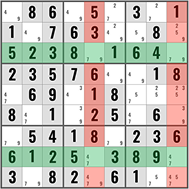
Alternating Inference Chains (AIC), sometimes called Nice Loops or Forcing Chains, are among the most powerful techniques in Sudoku. They generalize many common techniques — X-Wing, Skyscraper, XY-Wing, and Simple Coloring can all be expressed as specific types of AICs. While they require understanding of strong and weak links, AICs can break through puzzles that no other named technique can solve.
Prerequisites
Before learning AICs, you should be comfortable with:
- Candidate notation (pencil marks) — complete candidates in every cell
- Strong links — when a candidate appears in exactly two cells in a house, or a cell has exactly two candidates
- Weak links — when two cells share a house and both contain the same candidate, or two candidates in the same cell
- Simple Coloring — single-digit chains using strong links
- All intermediate and most advanced techniques
Understanding Links
Strong Links
A strong link means: if one is false, the other must be true. Two types:
- Same digit, two cells in a house — When a digit appears in exactly two cells in a row, column, or box. If one cell doesn’t have the digit, the other must.
- Same cell, two candidates — When a cell has exactly two candidates. If one is false, the other must be true (bivalue cell).
Weak Links
A weak link means: if one is true, the other must be false (but both could be false). Two types:
- Same digit, two cells in a house — If one cell has the digit, the other can’t (same house constraint). This is always a weak link; it’s also strong if those are the only two cells.
- Same cell, two candidates — If one candidate is placed, the other is eliminated.
Notation
AICs are often written as chains of candidates:
A = B - C = D - E = F
Where = means strong link and - means weak link.
Types of AIC
Discontinuous AIC (Type 1) — Elimination Chain
A chain where both ends are strong links pointing to the same candidate in cells that are weakly linked:
A = B - C = D - E = F where A and F see each other
If A is false → B is true (strong) → C is false (weak) → D is true (strong) → E is false (weak) → F is true (strong). If A is true, F could be either. But crucially, at least one of A or F must be true — so any cell seeing BOTH A and F can have the candidate eliminated.
Continuous AIC (Nice Loop)
When the chain forms a closed loop where every link alternates strong/weak perfectly:
A = B - C = D - E = F - A
In a nice loop, every strong link endpoint must be true (one of the pair), and every weak link connection means both can’t be true. This allows:
- Eliminations at weak link junctions (remove the candidate from other cells seeing both endpoints of a weak link)
- Placements at strong link junctions (if the chain forces a value)
Discontinuous AIC (Type 2) — Placement Chain
When both ends of the chain converge to the same conclusion: a specific cell must contain a specific digit. This directly places that digit.
Worked Example
Let’s trace a simple AIC for candidate elimination.
After filling pencil marks, we identify:
- R1C5 has candidates {3, 7} — bivalue cell
- Column 5 has digit 3 in exactly two cells: R1C5 and R6C5 — conjugate pair
- R6C5 has candidates {3, 9} — bivalue cell
- Row 6 has digit 9 in exactly two cells: R6C5 and R6C2 — conjugate pair
The chain: R6C2(9) = R6C5(9) - R6C5(3) = R1C5(3) - R1C5(7)
Reading the chain:
- If R6C2 ≠ 9, then R6C5 = 9 (strong link on 9 in row 6)
- If R6C5 = 9, then R6C5 ≠ 3 (weak link — same cell)
- If R6C5 ≠ 3, then R1C5 = 3 (strong link on 3 in column 5)
- If R1C5 = 3, then R1C5 ≠ 7 (weak link — same cell)
So either R6C2 = 9 or R1C5 = 7 (or both). Eliminate 7 from any cell that sees R1C5 AND 9 from any cell that sees R6C2… Actually, since the endpoints are different candidates, this is more nuanced.
But notice: this chain is equivalent to an XY-Wing with R6C5 as the pivot, R6C2 and R1C5 as pincers. AIC generalizes the logic to chains of any length.
Common Techniques as AICs
| Technique | AIC representation |
|---|---|
| X-Wing | Two strong links on same digit, continuous loop |
| Skyscraper | Two strong links on same digit, discontinuous |
| XY-Wing | Three bivalue cells, mixed strong/weak links |
| Simple Coloring | Chain of strong links on one digit |
| W-Wing | Two bivalue cells + one strong link |
Understanding AICs reveals why all these techniques work and helps you find patterns that don’t fit any named technique.
Common Mistakes to Avoid
Mixing up strong and weak links. The chain MUST alternate: strong, weak, strong, weak, etc. If two consecutive links are both strong (or both weak), the chain logic breaks.
Not verifying link strength. A link between two cells on a digit is strong ONLY if there are exactly two cells with that digit in the house. Check carefully.
Overly long chains. While AICs can be any length, extremely long chains are error-prone. If you’re building chains of 10+ links, verify each step carefully.
Forgetting bivalue cell links. Strong links can exist within a single cell (bivalue → if one candidate is false, the other is true). These are essential for building AICs across multiple digits.
Not knowing when to stop. If you haven’t found an AIC after checking major candidates, the puzzle may require an even more advanced technique (like ALS or forcing nets).
When to Use AICs
AICs are expert to evil-level techniques — use them as a last resort after all named techniques fail:
- All basic and intermediate techniques
- All fish patterns (X-Wing, Swordfish)
- All wing patterns (XY-Wing, XYZ-Wing)
- Simple Coloring
- Unique Rectangles
- W-Wings
AICs are the “general solver” that can handle what named techniques cannot.
Frequently Asked Questions
Are AICs the most powerful solving technique?
For standard 9×9 Sudoku, AICs (combined with ALS as nodes) can solve virtually any puzzle that doesn’t require trial and error. They’re among the most powerful techniques available to human solvers.
How do AICs relate to “Nice Loops”?
Nice Loops are the continuous (closed loop) form of AICs. The term comes from the solving community and describes loops where the inference chain returns to its starting point with perfectly alternating links.
Can software find AICs automatically?
Yes. Most advanced Sudoku solvers (including the SudokuPulse solver) can identify and apply AICs. For human solvers, finding AICs requires practice and familiarity with strong/weak link patterns.
Do I need to learn AICs to solve Evil puzzles?
Not necessarily. Most Evil puzzles on SudokuPulse can be solved using the named techniques (X-Wing, Swordfish, Wings, Unique Rectangles, W-Wings, etc.). AICs are useful when none of those specific patterns appear and you need a general approach.
Practice Chains
Try our Evil difficulty puzzles for the most challenging chain-based solving opportunities.