
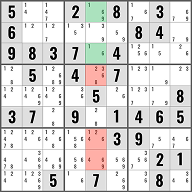
Box-Line Reduction (also called Claiming or Box/Line Interaction) is an intermediate Sudoku technique and the inverse of the Pointing Pair / Pointing Triple technique. While pointing pairs look at a candidate confined to one line within a box and eliminate from the line, Box-Line Reduction looks at a candidate confined to one box within a line and eliminates from the box.
Together, pointing pairs and Box-Line Reduction form the complete set of Locked Candidates techniques.
Prerequisites
Before learning Box-Line Reduction, you should be comfortable with:
- Candidate notation (pencil marks) — complete candidates in every cell
- Naked singles and hidden singles — foundational solving
- Pointing pairs — the complementary locked candidates technique
What is Box-Line Reduction?
Box-Line Reduction occurs when a candidate in a row (or column) is restricted to cells within a single box. Since the candidate must go somewhere in that row/column, and it can only go within that one box, it must be in one of those cells. Therefore, the candidate can be eliminated from all other cells in the box that are NOT in that row/column.
Pointing Pair vs. Box-Line Reduction
These are complementary techniques — both are forms of “locked candidates”:
| Technique | Starting point | Elimination from |
|---|---|---|
| Pointing Pair | Candidate in a box → confined to one row/col | Other cells in the row/column outside the box |
| Box-Line Reduction | Candidate in a row/col → confined to one box | Other cells in the box outside the row/column |
Both exploit the same intersection of a line and a box, but from opposite perspectives.
How to Find Box-Line Reduction: Step-by-Step
Step 1: Pick a Row or Column
Scan your grid row by row (or column by column).
Step 2: Check Where a Candidate Appears
For each candidate digit in the row/column, note which boxes the cells belong to. If all occurrences of the candidate are within a single box, you have a Box-Line Reduction.
Step 3: Eliminate from the Box
Remove the candidate from all cells in that box that are NOT in the row/column.
Worked Example: Row-Based
Looking at Row 4 and the candidate 8:
| Col 1 | Col 2 | Col 3 | Col 4 | Col 5 | Col 6 | Col 7 | Col 8 | Col 9 | |
|---|---|---|---|---|---|---|---|---|---|
| Row 4 | 3 | 7 | 2 | 9 | 1 | 6 |
The empty cells in Row 4 are at C3, C5, and C6. After checking other constraints:
- R4C3 has candidates {4, 5}
- R4C5 has candidates {4, 8}
- R4C6 has candidates {5, 8}
Candidate 8 appears in Row 4 only in columns 5 and 6. Both C5 and C6 are in Box 5 (rows 4-6, columns 4-6).
Since 8 in Row 4 must be in one of these Box 5 cells, 8 cannot be anywhere else in Box 5.
Elimination: Remove 8 from R5C4, R5C5, R5C6, R6C4, R6C5, and R6C6 — any of these that have 8 as a candidate (except R4C5 and R4C6, which are in both Row 4 and Box 5).
Worked Example: Column-Based
Looking at Column 7 and the candidate 2:
Suppose candidate 2 in Column 7 appears only in R1C7 and R3C7. Both cells are in Box 3 (rows 1-3, columns 7-9).
Since 2 in Column 7 must be in Box 3, eliminate 2 from all other cells in Box 3 that aren’t in Column 7:
- Remove 2 from R1C8, R1C9, R2C7 (if 2 not already there), R2C8, R2C9, R3C8, R3C9 — any that have 2 as a candidate.
Common Mistakes to Avoid
Confusing with pointing pairs. If you start from the box and find a candidate confined to one line, that’s a pointing pair. If you start from the line and find it confined to one box, that’s Box-Line Reduction. The trigger is different even though the logic is related.
Eliminating from the line instead of the box. Box-Line Reduction eliminates from the box (outside the line), not from the line.
Missing the pattern because the line spans three boxes. A row spans three boxes. You need the candidate to be in only ONE of those three boxes. If it’s in two or three, there’s no Box-Line Reduction.
Incomplete pencil marks. As always, locked candidate patterns require accurate candidates.
When to Look for Box-Line Reduction
Box-Line Reduction is an intermediate technique — use it after:
- All naked singles and hidden singles
- Before or alongside naked pairs and hidden pairs
It’s at the same difficulty level as pointing pairs and should be part of your regular scanning routine for Medium and Hard puzzles.
Frequently Asked Questions
Is Box-Line Reduction the same as Claiming?
Yes. “Claiming” is an alternative name used in some solving software (like HoDoKu). The line “claims” the candidate within the box.
How common is Box-Line Reduction?
Very common in Hard and above puzzles. It’s one of the core intermediate techniques that every solver should know. On SudokuPulse, Hard puzzles regularly require locked candidates (both pointing and claiming).
Should I look for Box-Line Reduction before or after pointing pairs?
Look for both at the same time. They’re complementary — when scanning a box-line intersection, check both directions. Many solvers naturally check both as a single scanning step.
Can Box-Line Reduction produce multiple eliminations?
Yes. If a box has several cells with the candidate outside the line, all of them get eliminated in one step. This can be very powerful.
Practice Box-Line Reduction
Try our Hard or Expert puzzles to practice locked candidates.