
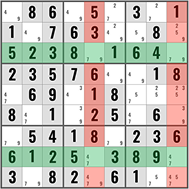
Almost Locked Sets (ALS) are among the most advanced Sudoku techniques. An ALS is a group of N cells within a single house that collectively contain N+1 candidate digits. This is “almost” locked because if any one digit were removed, the remaining N digits would be perfectly locked into the N cells (a naked subset). ALS-based techniques use two or more Almost Locked Sets connected by shared candidates to produce eliminations.
Prerequisites
Before learning ALS, you should be comfortable with:
- Naked pairs, triples, and quads — ALS extends locked set logic
- Strong and weak links — understanding how candidates interact across houses
- XY-Wings — ALS-XZ generalizes the XY-Wing pattern
- Most other advanced techniques — ALS is typically a last-resort technique
What is an Almost Locked Set?
A Locked Set (naked subset) has N cells with exactly N candidates. An Almost Locked Set adds one more candidate:
| Structure | Cells | Candidates | Status |
|---|---|---|---|
| Naked single | 1 | 1 | Locked |
| ALS (1 cell) | 1 | 2 | Almost locked (bivalue cell) |
| Naked pair | 2 | 2 | Locked |
| ALS (2 cells) | 2 | 3 | Almost locked |
| Naked triple | 3 | 3 | Locked |
| ALS (3 cells) | 3 | 4 | Almost locked |
Every bivalue cell is a 1-cell ALS. Every set of N cells with N+1 candidates in a house is an ALS.
Key Property
If you can determine that one specific digit goes elsewhere (not in the ALS), the remaining N digits are locked into the N cells. This is the mechanism that makes ALS-based eliminations work.
ALS-XZ Rule (Two ALS Connected)
The most common ALS technique is ALS-XZ, which uses two Almost Locked Sets:
Setup
- ALS A — a group of cells with N+1 candidates in a house
- ALS B — a different group of cells with M+1 candidates in a house
- Restricted Common Candidate (X) — a digit that appears in both ALS A and ALS B, where ALL instances of X in A and ALL instances of X in B see each other (restricted common)
- Non-Restricted Common Candidate (Z) — another digit that appears in both ALS A and ALS B
Elimination
Remove Z from any cell that can see ALL instances of Z in ALS A and ALL instances of Z in ALS B.
Why It Works
Since X is a restricted common, it can be in A or B but not both. If X goes in ALS A, then ALS B loses X and becomes a locked set (N digits in N cells) — locking Z into the cells of B where it appears. If X goes in ALS B, then ALS A becomes a locked set — locking Z into A’s cells. Either way, Z is locked into one of the two ALS groups. So any cell seeing all Z’s in both groups can’t have Z.
Worked Example: ALS-XZ
Consider:
ALS A (in Box 1): R1C1 = {1, 3, 5} and R2C3 = {3, 7}
- 2 cells, 4 candidates {1, 3, 5, 7} — wait, that’s N=2 cells with 4 candidates, which is N+2. Not valid.
Let me correct: ALS A (in Row 1): R1C1 = {1, 3, 5}, R1C4 = {1, 5}
- 2 cells, 3 candidates {1, 3, 5} — valid ALS (N=2, N+1=3 candidates)
ALS B (in Box 4): R4C1 = {3, 7}, R5C2 = {5, 7}
- 2 cells, 3 candidates {3, 5, 7} — valid ALS
Restricted common (X): Digit 3 appears in R1C1 (ALS A) and R4C1 (ALS B). Both are in Column 1 — they see each other. Check that ALL 3s in A see all 3s in B: ALS A has 3 only in R1C1, ALS B has 3 only in R4C1. They’re in the same column. Restricted common = 3. ✓
Non-restricted common (Z): Digit 5 appears in both ALS A ({R1C1, R1C4}) and ALS B ({R5C2}). These don’t all need to see each other (and they don’t — R1C4 doesn’t see R5C2).
Elimination: Remove 5 from any cell that sees ALL 5s in ALS A AND all 5s in ALS B. The 5s in ALS A are at R1C1 and R1C4. The 5 in ALS B is at R5C2. Any cell that sees R1C1, R1C4, AND R5C2 can have 5 eliminated.
ALS as Nodes in Chains
ALS groups can also serve as nodes in Alternating Inference Chains (AICs). When a chain passes through an ALS, the almost-locked property provides the strong link: if one digit exits the ALS, the remaining digits are locked. This dramatically increases the power of chain-based solving.
Common Mistakes to Avoid
Cells not in the same house. All cells in an ALS must be in the same row, column, or box. A random collection of cells doesn’t form a valid ALS.
Wrong candidate count. An ALS has N cells with exactly N+1 candidates. If the count is N+2 or more, it’s not an ALS.
Restricted common not truly restricted. ALL instances of the restricted common in both ALS groups must see each other. If even one instance is outside the visibility zone, it’s not a valid restricted common.
Forgetting single-cell ALS. A bivalue cell is a valid 1-cell ALS. Many ALS-XZ patterns use bivalue cells as one (or both) of the ALS groups. In fact, an XY-Wing is an ALS-XZ where both ALS groups are single bivalue cells.
Overlooking box-based ALS. ALS groups in boxes can be very powerful because they interact with both rows and columns.
When to Use ALS
ALS techniques are among the most advanced — use them only after exhausting:
- All basic and intermediate techniques
- All fish patterns and wing patterns
- Simple Coloring and Unique Rectangles
- W-Wings and simpler chain patterns
ALS-based techniques are rarely needed for standard puzzles, even at Expert level. They most commonly appear in the absolute hardest puzzles or in solving competitions.
Frequently Asked Questions
How common are ALS patterns?
ALS-XZ patterns are relatively common in hard puzzles — many XY-Wings are technically ALS-XZ. However, ALS patterns involving 2+ cell groups are rare in standard difficulty puzzles and mostly appear in extremely difficult grids.
Is ALS the most powerful technique?
ALS combined with chains (ALS as chain nodes) can solve virtually any standard Sudoku puzzle. It’s among the most powerful techniques available, alongside full-length AICs.
Do I need to learn ALS to solve puzzles on SudokuPulse?
For Easy through Expert: no. For Evil: probably not, as the named techniques usually suffice. ALS is more valuable for extremely hard puzzles beyond standard difficulty tiers.
How does ALS-XZ relate to XY-Wing?
An XY-Wing is a special case of ALS-XZ where both ALS groups are single bivalue cells and the pivot provides the restricted common. Understanding ALS helps you see why XY-Wings work and find similar patterns at larger scales.
Practice ALS
For the most challenging puzzles that may require ALS, try our Evil difficulty.