

If you’ve ever played Sudoku on different websites, you’ve probably noticed that “medium” on one site can feel like “hard” on another. Difficulty labels vary widely between apps, books, and websites—and there’s no universal standard for what “easy” or “evil” actually means.
This guide explains what actually makes a Sudoku puzzle difficult, how popular sites like Sudoku.com, NYT Sudoku, and SudokuPulse define their difficulty levels, and how those levels compare in practice.
What Makes a Sudoku Difficult?
Many people assume that fewer starting numbers (called givens) means a harder puzzle. This is one of the most common misconceptions in Sudoku. A puzzle with 17 givens can be trivially easy, while a puzzle with 35 givens could require advanced techniques to solve.
The real factors that determine difficulty are:
1. Techniques Required
This is the single biggest factor. Every Sudoku puzzle can be solved using a series of logical techniques, ranging from simple to extremely advanced. The harder the most advanced technique you need to complete the puzzle, the harder the puzzle is.
Here’s a rough progression of techniques from easiest to hardest:
| Technique | Difficulty |
|---|---|
| Last Digit / Full House | Trivial |
| Hidden Single (Box) | Easy |
| Hidden Single (Line) | Easy |
| Naked Single | Easy–Medium |
| Naked Pair / Hidden Pair | Medium |
| Locked Candidates (Pointing/Claiming) | Medium |
| Naked Triple / Hidden Triple | Medium–Hard |
| X-Wing | Hard |
| Swordfish | Hard |
| Skyscraper / Two-String Kite | Hard–Expert |
| Y-Wing / XYZ-Wing | Expert |
| Unique Rectangle | Expert |
| X-Chain / Forcing Chains | Expert–Evil |
A puzzle labelled “easy” should be solvable using only basic scanning and hidden singles. A puzzle labelled “evil” or “expert” typically requires multiple advanced techniques.
2. How Often You Get Stuck
Two puzzles might both require a naked pair to solve, but one might need it once while the other needs it five times at different points. The more frequently you need to apply difficult techniques, the harder and more time-consuming the puzzle feels.
3. How Obvious the Next Step Is
Sometimes a technique is easy to apply but hard to spot. If there are very few candidates to work with, an X-Wing might jump out at you. But if the grid is cluttered with possibilities, even finding a hidden single can be a slog. Puzzles where you have to search carefully for each next move feel much harder than puzzles where progress flows naturally.
4. Tediousness
A puzzle where you can find many hidden singles at each step will feel fast and enjoyable. A puzzle where there’s exactly one hidden single to find in the entire grid at each step will feel tedious, even though the technique required is the same.
Standard Rating Systems
There are two well-known, standardized systems for rating Sudoku difficulty:
SE Rating (SudokuExplainer)
The SE rating comes from the program Sudoku Explainer. It works by solving the puzzle step by step and recording which techniques are needed. The final rating is the maximum difficulty of any single technique used—essentially, the hardest thing you need to know.
The SE scale runs from 1.0 to 11.9:
| SE Rating | Approximate Level | Techniques Needed |
|---|---|---|
| Up to 1.2 | Easy | Last Digit, Hidden Single (Box) |
| Up to 2.0 | Medium | Hidden Single (Line), Naked Single |
| Up to 3.0 | Hard | Pairs, Locked Candidates |
| Up to 4.0 | Expert | X-Wing, Swordfish, Skyscraper |
| Up to 7.5 | Very Advanced | Chains |
| Above 8.0 | Extreme | Forcing Chains, Advanced Patterns |
Most newspaper puzzles top out around SE 3.0. Everything above that requires techniques you’d only encounter in a dedicated Sudoku app.
HoDoKu Rating
The HoDoKu rating (from the program of the same name) takes a different approach. Instead of using the hardest technique, it sums up the difficulty of every technique used across the entire solve. This means it measures total work rather than peak difficulty.
A puzzle needing one chain scores lower than one needing twenty chains, even though both require the same skill. HoDoKu is better at predicting how long a puzzle will take to solve.
Approximate HoDoKu categories:
| HoDoKu Score | Level |
|---|---|
| ~450 | Easy |
| ~550 | Medium |
| ~650 | Hard |
| ~1000 | Very Hard |
| ~1500 | Vicious |
| ~2000+ | Devilish |
How Different Sites Define Difficulty
Each site has its own internal method for grading puzzles. We ran a sample of puzzles from each site through our solver to see the technique difficulty required. Here’s how the major Sudoku sites break down their levels.
Sudoku.com
Sudoku.com offers six difficulty levels: Easy, Medium, Hard, Expert, Master, and Extreme. On the surface, that sounds like a wide range—but when you analyze what techniques each level actually requires, the picture is very different.
Easy (38 givens)
| Givens | Last Digit | Hidden Single (Box) |
|---|---|---|
| 38 | 19–21 | 22–24 |
Every Easy puzzle is solvable with just Last Digit and Hidden Single (Box). No variation in givens, no variation in technique. Completely uniform.
Medium (36–38 givens)
| Givens | Last Digit | Hidden Single (Box) |
|---|---|---|
| 36–38 | 19–21 | 22–25 |
Medium is functionally identical to Easy. The only difference is that a few puzzles drop to 36 givens instead of 38. The techniques required are exactly the same: Last Digit and Hidden Single (Box). That’s it.
Hard (30–36 givens)
| Givens | Last Digit | Hidden Single (Box) | Hidden Single (Line) |
|---|---|---|---|
| 30–36 | 19–21 | 18–31 | 0–1 |
Hard drops the given count but barely changes the technique requirements. Most Hard puzzles are still solvable with the exact same techniques as Easy and Medium. Occasionally one Hidden Single (Line) appears—a technique that’s only marginally harder than Hidden Single (Box).
In other words, Easy, Medium, and Hard on Sudoku.com are essentially the same difficulty. The labels give the illusion of progression, but the only real change is how many numbers you start with. The logical challenge is virtually identical.
Expert (30–32 givens)
| Givens | Last Digit | Hidden Single (Box) | Hidden Single (Line) | Naked Single |
|---|---|---|---|---|
| 30–32 | 18–21 | 28–33 | 0–5 | 0–1 |
Expert introduces Hidden Single (Line) more consistently and occasionally a Naked Single, but many Expert puzzles are indistinguishable from Hard. The jump from Hard to Expert is minimal.
Master (24–30 givens)
| Givens | Last Digit | Hidden Single (Box) | Hidden Single (Line) | Naked Single | Hidden Pair |
|---|---|---|---|---|---|
| 24–30 | 19–21 | 25–31 | 3–7 | 0–3 | 0–3 |
Master is the first level that consistently requires techniques beyond basic scanning. Hidden Single (Line) appears in every puzzle, and Hidden Pairs and Naked Singles show up regularly. This is where Sudoku.com difficulty starts to actually feel different.
Extreme (22–28 givens)
| Givens | Last Digit | Hidden Single (Box) | Hidden Single (Line) | Naked Single | Hidden Pair | Other Techniques |
|---|---|---|---|---|---|---|
| 22–28 | 19–21 | 26–34 | 1–8 | 0–7 | 0–5 | Locked Candidates, Naked Pairs, Skyscraper |
Extreme is Sudoku.com’s hardest level, and it does introduce a handful of intermediate techniques like Locked Candidates, Naked Pairs, and the occasional Skyscraper. However, it’s worth noting that even Extreme does not require many truly advanced techniques. There are no X-Wings, no Swordfish, no Y-Wings, no Unique Rectangles. Techniques that dedicated Sudoku apps consider standard for “hard” puzzles are absent from Sudoku.com entirely.
The takeaway: Sudoku.com’s difficulty system is heavily weighted toward the beginner end of the spectrum. Their first three levels are nearly identical, Expert barely differs from Hard, and even their hardest puzzles (Extreme) would be considered intermediate by most serious Sudoku standards.
NYT Sudoku (New York Times)
The New York Times offers three difficulty levels. Unlike Sudoku.com, NYT actually delivers meaningful progression between levels.
Easy (38 givens)
| Givens | Last Digit | Hidden Single (Box) |
|---|---|---|
| 38 | 19–21 | 22–24 |
NYT Easy is identical in structure to Sudoku.com’s Easy, Medium, and Hard—just Last Digit and Hidden Single (Box) with a consistent 38 givens. Clean, uniform, beginner-friendly.
Medium (23–26 givens)
| Givens | Last Digit | Hidden Single (Box) | Hidden Single (Line) | Naked Single | Hidden Pair | Naked Pair | Locked Candidate |
|---|---|---|---|---|---|---|---|
| 23–26 | 18–21 | 26–32 | 1–8 | 1–6 | 0–1 | 0–2 | 0–5 |
This is a significant jump from Easy. The given count drops to 23–26, and every Medium puzzle requires Hidden Singles in both boxes and lines, Naked Singles, and usually at least one of: Hidden Pair, Naked Pair, or Locked Candidates. NYT Medium is already harder than Sudoku.com’s Expert.
Hard (22–26 givens)
| Givens | Last Digit | Hidden Single (Box) | Hidden Single (Line) | Naked Single | Hidden Pair | Naked Pair | Locked Candidate | Others |
|---|---|---|---|---|---|---|---|---|
| 22–26 | 18–21 | 23–35 | 3–8 | 0–6 | 1–5 | 0–3 | 0–3 | Occasional Hidden Triple, Naked Triple |
NYT Hard consistently requires a broad mix of intermediate techniques: Hidden/Naked Pairs, Locked Candidates, and occasionally Hidden Triples and Naked Triples. These puzzles represent a genuine challenge that requires pencil marks and systematic elimination. However, NYT Hard still stops short of truly advanced techniques—no X-Wings, no Swordfish, no Y-Wings.
The takeaway: NYT does a much better job than Sudoku.com at creating distinct difficulty levels. Their Medium is already more demanding than Sudoku.com’s Expert, and their Hard is roughly on par with Sudoku.com’s Master/Extreme. But even NYT’s hardest puzzles don’t venture into advanced pattern-based techniques.
SudokuPulse
SudokuPulse offers five difficulty levels. We ran the same solver analysis across all puzzle pools:
Easy (37 givens) — 2 techniques
| Givens | Last Digit | Hidden Single (Box) |
|---|---|---|
| 37 | 21 | 30 |
Easy puzzles use only Last Digit and Hidden Single (Box)—the same two basic techniques found in Sudoku.com’s first three levels and NYT Easy. A relaxed, beginner-friendly experience.
Medium (31–37 givens) — 2 techniques
| Givens | Last Digit | Hidden Single (Box) |
|---|---|---|
| 31–37 | 21 | 32 |
Medium uses the same two techniques as Easy but introduces a wider range of givens (as low as 31). The technique requirement is identical, but fewer starting numbers means more scanning is needed. This makes Medium a comfortable step up without adding new concepts.
Hard (22–30 givens) — 6 techniques
| Givens | Last Digit | Hidden Single (Box) | Hidden Single (Line) | Naked Single | Hidden Pair | Locked Candidate |
|---|---|---|---|---|---|---|
| 22–30 | 21 | 39 | 13 | 5 | 5 | 3 |
Hard is where SudokuPulse takes a real leap. Four new techniques appear: Hidden Single (Line), Naked Single, Hidden Pair, and Locked Candidates. The given count drops significantly, and pencil marks become essential. This level maps closely to NYT Medium and Hard.
Expert (22–30 givens) — 10 techniques
| Givens | Last Digit | Hidden Single (Box) | Hidden Single (Line) | Naked Single | Hidden Pair | Naked Pair | Locked Candidate | Hidden Triple | Naked Triple | X-Wing | Swordfish | Skyscraper | Two-String Kite | Crane |
|---|---|---|---|---|---|---|---|---|---|---|---|---|---|---|
| 22–30 | 21 | 35 | 10 | 7 | 5 | 3 | 6 | 1 | 1 | 1 | 1 | 2 | 2 | 2 |
Expert is where SudokuPulse goes beyond anything NYT or Sudoku.com offer. On top of all the Hard techniques, Expert adds Naked Pairs, Hidden/Naked Triples, and a suite of advanced pattern techniques: X-Wing, Swordfish, Skyscraper, Two-String Kite, and Crane. These puzzles require strong pattern recognition and familiarity with line-based elimination.
Evil (23–30 givens) — 13 techniques
| Givens | Last Digit | Hidden Single (Box) | Hidden Single (Line) | Naked Single | Hidden Pair | Naked Pair | Locked Candidate | Hidden Triple | Naked Triple | X-Wing | Swordfish | Skyscraper | Two-String Kite | Crane |
|---|---|---|---|---|---|---|---|---|---|---|---|---|---|---|
| 23–30 | 21 | 37 | 10 | 6 | 4 | 6 | 8 | 1 | 1 | 2 | 1 | 2 | 2 | 1 |
| Y-Wing | Finned/Sashimi X-Wing | XYZ-Wing | Empty Rectangle | W-Wing | Unique Rectangle Type 1 | Unique Rectangle Type 2 | Unique Rectangle Type 3 | Unique Rectangle Type 4 |
|---|---|---|---|---|---|---|---|---|
| 3 | 2 | 2 | 2 | 4 | 1 | 1 | 1 | 1 |
Evil is the hardest level on SudokuPulse, and it shows. On top of everything Expert requires, Evil adds nine more technique types: Y-Wing, XYZ-Wing, Finned/Sashimi X-Wing, Empty Rectangle, W-Wing, and four types of Unique Rectangle. With 13 different technique types appearing on average, these puzzles demand the widest skill set of any level on any of the three sites.
The takeaway: SudokuPulse’s Easy and Medium cover the same ground as Sudoku.com and NYT Easy—basic scanning with Hidden Singles. Hard matches NYT’s Medium and Hard tiers. But Expert and Evil go well beyond what either NYT or Sudoku.com ever reach, introducing genuinely advanced pattern-based techniques. The givens for Hard, Expert, and Evil are all similar (22–30), yet the solving experience is vastly different—reinforcing that givens don’t determine difficulty, techniques do.
Side-by-Side Comparison
The table below shows which techniques are required at each difficulty level across all three sites. A green circle means the technique appears regularly; a yellow circle means it appears occasionally.
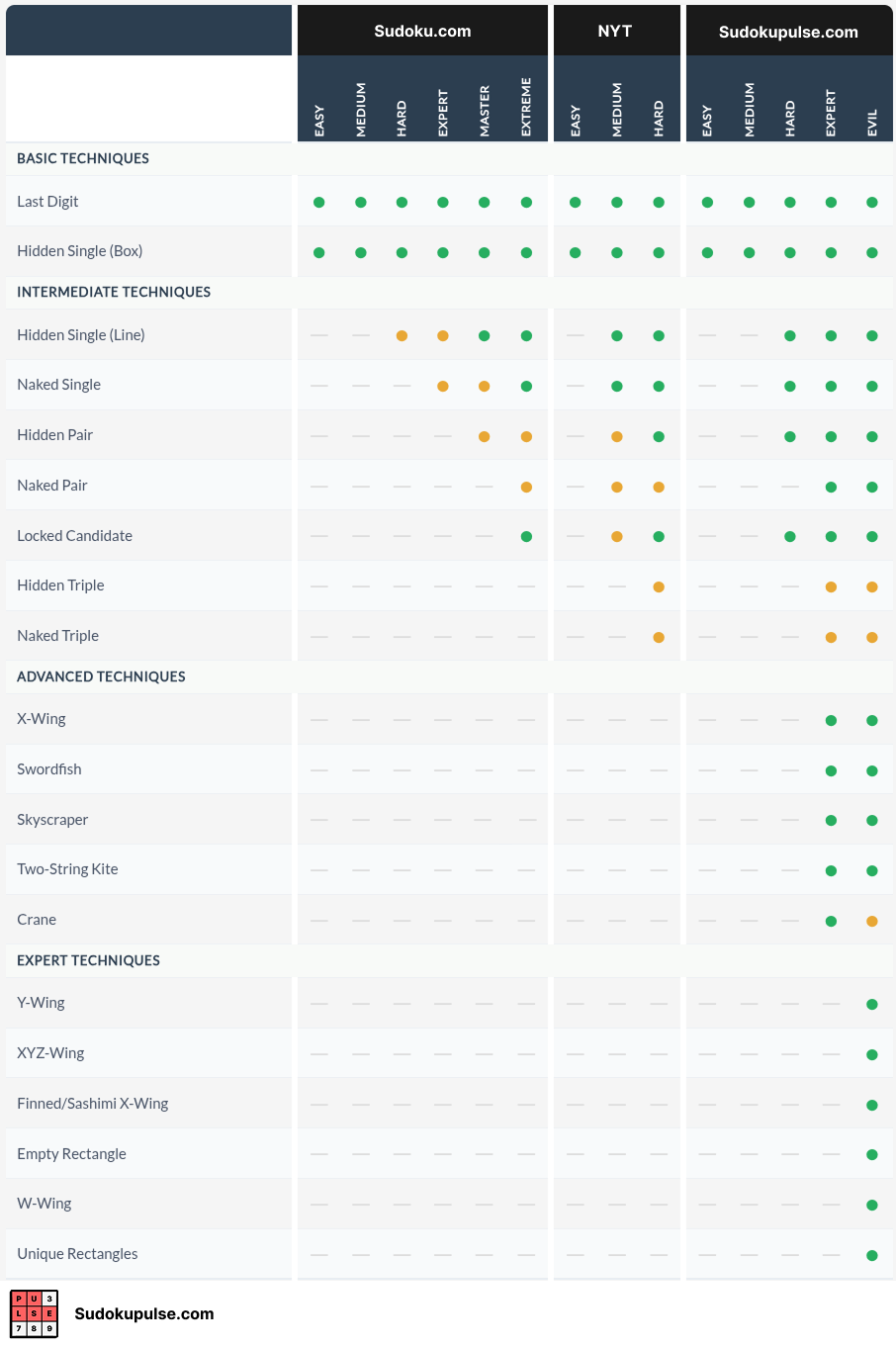
Key takeaways:
- Sudoku.com’s Easy, Medium, and Hard are effectively the same puzzle. They all require only Last Digit and Hidden Single (Box). The labels create a false sense of progression—only the number of givens changes, not the logic.
- Sudoku.com’s Extreme is still relatively basic. It tops out at Locked Candidates and Naked Pairs, with no X-Wings, Y-Wings, or advanced chain techniques. By most standards, their hardest puzzles are intermediate.
- NYT delivers real progression across three levels. NYT Medium already surpasses Sudoku.com’s Expert in technique requirements, and NYT Hard is roughly on par with Sudoku.com’s Master/Extreme. But even NYT Hard stops short of advanced pattern techniques.
- SudokuPulse covers the full spectrum. Easy and Medium handle basic scanning (like NYT Easy and Sudoku.com’s first three levels). Hard introduces the intermediate techniques found in NYT Medium/Hard. Expert and Evil then go where neither NYT nor Sudoku.com venture—into genuinely advanced techniques like X-Wing, Swordfish, Y-Wing, Unique Rectangles, and more. With up to 13 different technique types in Evil, SudokuPulse offers the deepest difficulty range of the three.
How to Choose the Right Difficulty
If you’re not sure where to start, here’s a simple guide:
- Brand new to Sudoku? Start with Easy on any site. Learn hidden singles and enjoy the process.
- Comfortable with scanning? Move to Medium and start using pencil marks.
- Know your pairs and triples? Try Hard. This is where Sudoku starts to feel like a real logic challenge.
- Learned X-Wing and Swordfish? Expert-level puzzles will test those skills against real puzzles.
- Want the ultimate challenge? Evil/Extreme puzzles require you to combine multiple advanced techniques. Expect solves to take 30–60+ minutes.
The most important thing is to play at a level that’s challenging but not frustrating. If you’re stuck on every puzzle, drop down a level. If you’re breezing through, move up.
Why Difficulty Labels Don’t Tell the Whole Story
As the sudoku.coach difficulty article explains well, difficulty labels are ultimately arbitrary. Each app decides its own thresholds, and there’s no universal standard. The SE and HoDoKu ratings provide more objective measures, but most casual players never see those numbers.
What matters is understanding the techniques required at each level. If you know what techniques a difficulty label typically demands, you can gauge whether a puzzle is right for you—regardless of which site you’re playing on.
Ready to Play?
Pick your difficulty and start solving:
- Easy — Relax and build your fundamentals
- Medium — Practice pencil marks and pairs
- Hard — Take on locked candidates and triples
- Expert — Master advanced pattern techniques
- Evil — Conquer the hardest puzzles we offer
Or explore our technique guides to level up your skills before tackling the next difficulty tier.